The Blood Ceiling Was Debunked by a Guidebook
The Marks
A chi-tenjō is a blood ceiling. The boards overhead were once the floor of a room in which men killed themselves, and the stains they left are still in the wood, and if you stand underneath and look up you can make out hands and feet.
Several temples in and around Kyoto show one. It is a durable attraction, and it is at least two centuries old as an attraction.
The account most of them give is not the one this note follows. It goes back to the fall of Fushimi castle in 1600, when the commander and his men killed themselves in the corridors rather than surrender, and the boards they died on were afterwards set into the ceilings of several temples as a memorial. That is the standard story, and it is the one on the signboards. No blood ceiling has been shown by examination to carry human blood.
The most useful thing written about it in Japanese is a short essay by Minakata Kumagusu, published in an anthropology journal in 1915 and collected in his essays afterwards. It is titled for the handprints and footprints of ghosts, and what it does is assemble the cases — which is a different job from believing them and a different job from dismissing them.
What the Traveller Said
He opens with a quotation from an early nineteenth-century miscellany, reporting what someone was told by a man who had passed through Kyoto in 1832, during a public showing at the Great Buddha hall.
In the building where the treasures were kept, along a study veranda, there was a stretch of ceiling boards about two ken wide and ten shaku long. On it were the marks of hands and of feet, in blood, and marks that looked as though something had been dragged. Some of the colour was red and some had gone black. The whole surface of the boards was like that.
And the explanation people gave: when the regent Hidetsugu was made to die, those who followed him cut their bellies and stabbed one another, and the floorboards from that room were afterwards made into this ceiling.
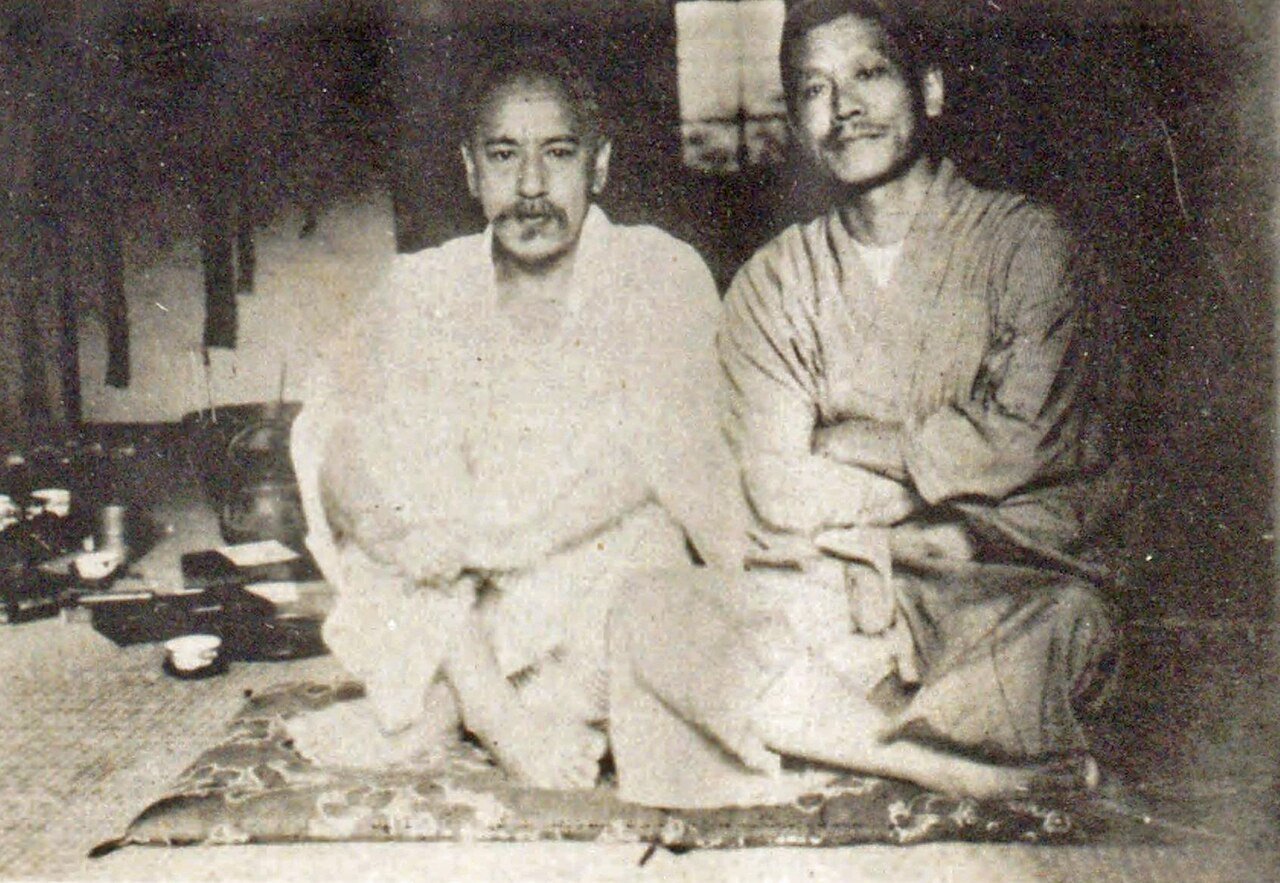
Minakata Kumagusu. Public domain, via Wikimedia Commons.
He Went and Looked
Then a sentence that is easy to read past, and which is the reason this essay is worth the trouble.
In 1882, he writes, when I climbed Mount Kōya, I saw a thing of that sort at the temple where Hidetsugu’s party killed themselves. Whether it is still there I do not know.
He is not reporting a belief. He is reporting that he went up the mountain as a young man, stood in that hall, and looked at the boards. Everything else in the essay is reading; this line is attendance.
The Guidebook Got There First
The third item is the one that rearranges the subject.
An illustrated guide to the Ise pilgrimage, printed in Osaka in 1797, describes a temple hall in the Watarai district where the ceiling shows many shapes of human hands and feet, red in colour, over the whole surface. The local account attaches them to two brothers of the Miyoshi who lost a battle there and killed themselves; the guide dates that to 1508, where modern histories put it a year later.
The guide then notes that there is a Momoyama blood ceiling at a temple in the capital as well, and that a temple in Sakai has the same kind of thing.
And having listed three, it draws its conclusion: considering these, this is the natural figuring of the wood grain, and not a staining by blood.
That is a travel guide — a book written to send people to places — telling its readers that the thing they are being sent to see is a pattern in a plank. The debunking is not the modern scholar’s contribution. It was printed in the guidebook, and the temples went on showing the ceilings anyway.
His Mother
Minakata then does something the guidebook could not, and puts in a piece of family evidence.
When he was small, his late mother told him that she had seen, on the ceiling of a temple hall at Amagasaki in Settsu, a great many bloody ghost footprints. And she had been told what they were: the tread of people who died in war or in disaster and cannot rest, walking about on top of the ceiling.
That is the explanation in its fully developed form. Not stains left by the dying, but prints made by the dead, from above, now.
The Question
And then he asks the question that the whole essay exists to ask, in one flat sentence.
If ghosts walk on top of the ceiling, there is no way it could be seen from below — so is it only ghosts’ footprints that come through the boards?
I have read a good deal of nineteenth and twentieth-century Japanese writing against superstition, and most of it argues from authority or from physics. This argues from carpentry. A footprint on the upper face of a plank is on the upper face of the plank. Somebody in that temple, at some point, had to decide that this particular kind of footprint soaks through, and nobody was ever going to say so out loud.
Why They Would Be Upside Down
Having got that far he goes after the underlying idea — that the unquiet dead walk inverted — and this is where the essay turns into a piece of comparative work.
He finds the image in an early eighteenth-century play, where a painter looks up from his own screen painting and sees his wife walking head downward, treading the sky with her feet and moving along on her hands; and the line that follows is that it is said the dead on pilgrimage go inverted or backwards, unlike the living.
He notes that two earlier Edo books have women walking upside down, but flags that those had been crucified upside down, which is not the same claim.
Then he traces the belief to scripture: sutras in which the damned are hung head down from a tree by the king of hell’s men, in which a spirit is conjured hanging inverted in the air, and — the plainest of them — a treatise stating that those who die into hell go feet up and head down, and those who die into heaven go head up and feet down.
And he does not stop at Japan. He notes that medieval European Christians held the same, citing a twelfth-century illustration reproduced in a French history of medieval life.
His explanation of why is Voltaire’s, quoted: that people did not get made in the image of gods, but made gods in the image of people. We hang animals up by the feet to kill them, so hell hangs people up. And bats hang inverted in the dark caves where the dead used to be put.
What He Thought the Marks Were
His own account of the stains is two causes, and he gives his prior publications for both.
A traveller’s own shadow, thrown upside down on thick mist in an empty mountain — he had written that up in the same journal the year before. And ground tremors too slight for a person to feel, which set a house’s ceiling creaking oddly overhead.
Put those together, he says, and once you have a ceiling that makes noises at night, any patch of grain that looks a little like a hand or a foot becomes the place where the ghost walked.
The note on this site about strange fires deals with the first of those explanations turning up on a Japanese mountain under its European name. The same period of collecting, roughly 1900 to 1930, produced most of what this site works from — and the note on the places said to hold human pillars is built from the same man, arguing the same way, ten years later.
He does not say the temples are lying. He says the wood has grain, the ground moves, mist throws shadows, and every culture that kills animals by hanging them upside down has imagined a hell that does the same.
Sources
- Minakata Kumagusu 南方熊楠, “The hand and foot prints of ghosts” 幽霊の手足印, published in an anthropological journal in 1915 and collected in his volume of essays; read here in that collection. All the material above is from this essay.
- Quoted there: an early nineteenth-century miscellany, continuation, book eighty-five, for the report of the ceiling at the Great Buddha hall in Kyoto in 1832 and the account attaching it to Hidetsugu’s followers.
- Quoted there: an illustrated guide to the Ise pilgrimage, book three, for the ceiling in the Watarai district, the attribution to the Miyoshi brothers, the mention of a blood ceiling in the capital and another at Sakai, and the conclusion that these are the natural grain of the wood. The guide was printed in 1797; it was edited and illustrated by Shitomi Kangetsu, and its text is attributed to Akisato Ritō, though the authorship is not settled. The guide itself was not consulted for this note.
- Also quoted there, and not consulted in their own editions: a Japanese encyclopaedia of 1712 on a footprint left in a board at a temple in Yamato; a report in a folklore journal on a child’s footprint in a stone bridge in Hitachi; an early eighteenth-century play; two Edo books on women walking inverted; four Buddhist texts on the inverted damned; a French history of medieval life for a twelfth-century illustration; and a work of sociology on bats in burial caves.
- Minakata’s own two explanations refer to his earlier pieces in the same journal and in a newspaper of January 1914; neither was consulted for this note.
The readings in “The Guidebook Got There First” and “The Question” are KWAIDANOTE’s own.
Found an error? Write to kwaidanote@gmail.com — corrections are made on this page and dated.