The Tanuki Who Became the Abbot
The Figure by the Door
Outside restaurants and shopfronts across Japan there is a standing pottery animal in a straw hat, holding a sake flask in one hand and an account book in the other, with a round belly and a famously oversized scrotum. English-language writing about the tanuki — the Japanese raccoon dog — is largely writing about this figure.
The figure is not old. It was shaped in something close to its present form by a potter named Fujiwara Tetsuzō, who had been making tanuki since the Meiji period and settled at Shigaraki in Shiga prefecture around 1935. The standing tanuki of the shopfronts is younger than most of the people who walk past it.
The animal in the older records is doing something else entirely.
He Eats the Priest and Keeps the Post
A collection of legends and folktales gathered in Shizuoka prefecture and published in 1934 records a tanuki at a temple in the Fuji district.[1] It had been living off the bodies brought there for funerals. In the end it ate the head priest, moved into the inner room, and went on running the temple as him.
What it does next is the part that stays with me. It does not flee to the hills. It sets out by palanquin for Kyoto to have its clerical rank confirmed. It gets as far as a teahouse at Iwabuchi, where a local dog goes for it, and that is the end.
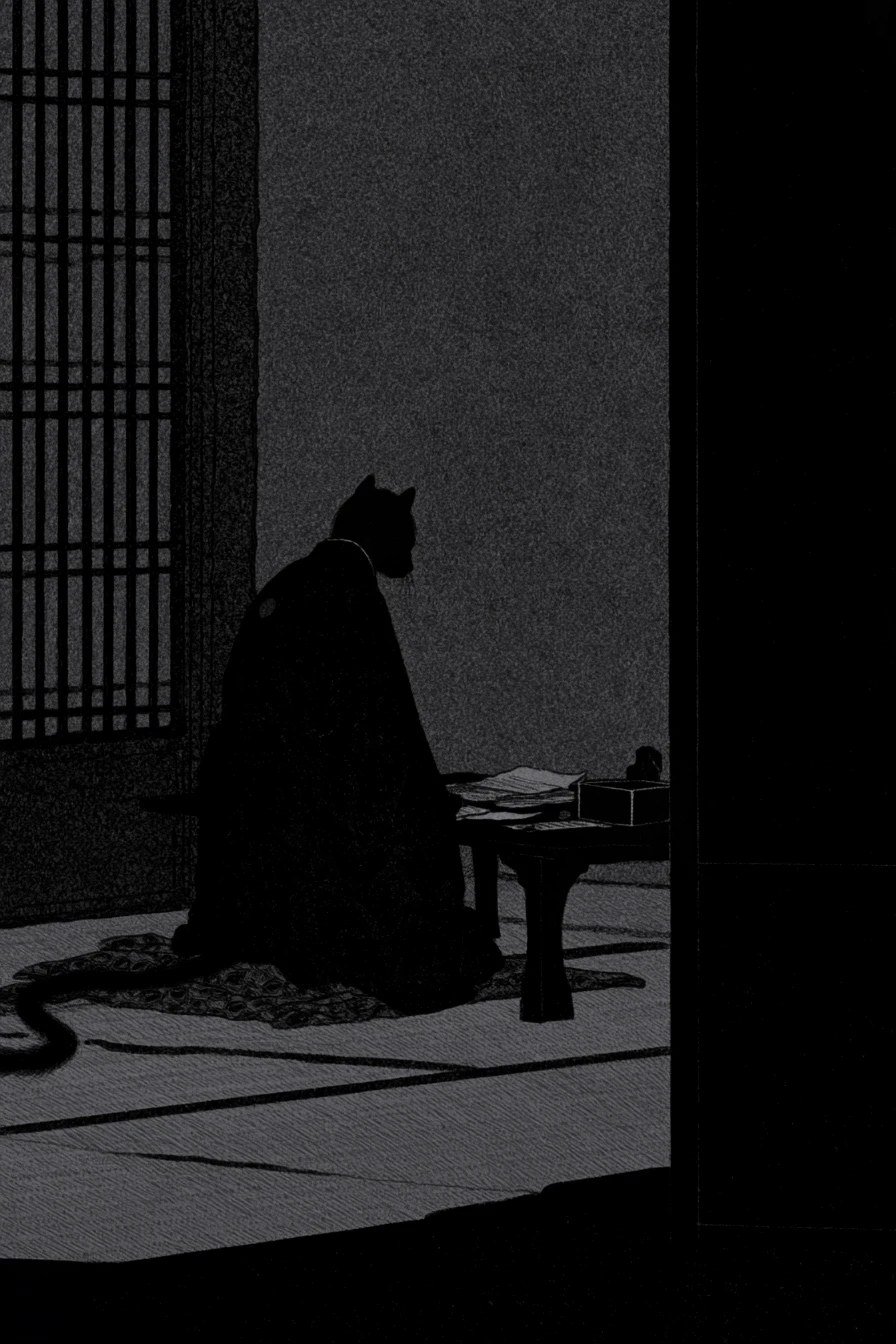
A second collection, of oral traditions gathered around Kamakura, has the same plot on a larger scale.[2] A tanuki living in the grounds of Kenchōji is said to have killed the head priests one after another over generations and to have occupied the abbacy itself — which, at Kenchōji, meant the first seat among the great Zen temples of Kamakura. Visiting a branch temple, it predicted that the old pine in the courtyard would soon die and offered to paint a pine on the cedar door panels. It painted the pine with its tail. The tree did die. When the real priest of the branch temple came back he watched a silhouette eating behind a paper screen and did not like the way it ate. The tanuki left, and on the road was killed by a watchdog.
These are two collections from two regions, recording stories told by different people, and they agree on a structure that no pottery figure prepares you for. The tanuki’s ambition is not mischief. It is tenure. And in both stories the thing that finally exposes it is a dog.
The Word Will Not Hold Still
The oldest citation usually given for the tanuki is an entry in the Nihon shoki under the year 627. It is eleven characters long. In the province of Mutsu there was a mujina; it changed into a person and sang.[3] There is no song, no name, and no outcome.
There is also, strictly, no tanuki. Mujina is a badger, a different animal that shares the same kind of burrow and gets confused with the raccoon dog constantly, including in the dictionaries. The graph 狸 that now writes tanuki was, in Chinese, the name of a wildcat that does not live in Japan, and Japanese writers attached it over the centuries to the raccoon dog, the badger, the wildcat, the flying squirrel and others.
The confusion runs right through the classical tales. Uji shūi monogatari has a hunter who doubts a bodhisattva that appears to him at night, shoots it, and finds an old tanuki in the valley below with his arrow in it. The Konjaku monogatarishū tells what is clearly the same story — and writes the animal with the characters for a wild boar.[4]
So the record does not really contain a natural history of the tanuki. It contains a series of writers choosing a graph.
The Kettle That Did Not Run Out
The one tanuki story with a wide English audience is Bunbuku chagama, usually told as a comedy in which a tanuki turns into a tea kettle and is made to walk a tightrope.
That is a children’s adaptation of the Meiji and Taishō periods. The older marvel is quieter and better. The temple of Mōrinji in Tatebayashi gives its own account: an old monk named Shukaku had served the abbots there since the founder’s time, and at a thousand-person service in 1570 he produced overnight a kettle that could be drawn from without ever running dry. In 1587, on a named day in the second month, he was seen asleep with fur on his hands and feet and a tail.
The temple writes the creature as a badger, and adds in brackets that there is also a view that it was a tanuki. Four centuries on, its own history declines to settle which animal it was. Yanagita Kunio, writing on the origins of folktales, separated the version in which the tanuki becomes a kettle and is sold for money from the older material, as a later and more complicated layer.[5] By around 1830 a miscellany of customs could already list the temple among the famous old sites of fox and tanuki transformation, noting that the kettle and the writing were still there to be seen.[6]
A second temple keeps a bunbuku kettle with no lid, at Jōkeiin in Yonezawa, and the two accounts of it do not match. A collection of hearth tales from the northeast tells it as a tanuki story: a young tanuki dances on a bridge of five colours holding the kettle, the priest breaks his promise not to laugh, the bridge goes, the animal falls into the pond and the lid is lost.[7] The city’s own account of the temple gives the kettle to a fox, and explains the missing lid quite differently — the iron lid turned back into a stone when the shape-changing broke, and a stone sits to this day on the wooden lid that replaced it.
One object, one temple, two animals and two explanations. The kettle is the fixed point. Everything told about it is negotiable.
Fox and Tanuki
In Edo-period writing the two animals are often not separate creatures but a single compound, kori, fox-and-tanuki, used for the category of things that have been got at somehow. Our note on foxes points to a magistrate’s notebook of 1795 whose heading assigns a disappearance to fox and tanuki while the entry beneath it never mentions either animal. The heading is a filing decision.
The tidy modern distinction — the fox seduces, the tanuki plays the fool — is repeated everywhere and is not well supported by the older texts. The tanuki of the temple stories is not a clown. It is a thing that ate a man and wore his office for years without anyone noticing.
What the Statue Left Out
One reading is that the friendly figure represents a softening: a feared animal domesticated into a shop mascot over the twentieth century. The records suggest something slightly different, because the animal in them was never mainly frightening. It was plausible.
The horror in the temple stories is administrative. Nobody screams. The community goes on holding funerals, the branch temples go on receiving visits, the paperwork for a promotion goes forward, and the arrangement holds until a dog, which has no opinion about clerical rank, settles it in the road.
Sources
- Shizuoka-ken densetsu mukashibanashi shū 静岡県伝説昔話集, collected by the folklore society of the Shizuoka prefectural women’s normal school, 1934; the Anyōji tanuki, recorded by Mochizuki Sadako.
- Kyōdo kenkyū 郷土研究, second series, volume of oral traditions; the Kenchōji tanuki and the painted cedar door, recorded by Naitō Chōji.
- Nihon shoki 日本書紀, 720; thirty-fifth year of Suiko, second month.
- Uji shūi monogatari 宇治拾遺物語, early 13th century, “A hunter shoots a buddha” Commons; and Konjaku monogatarishū 今昔物語集, 12th century, book twenty, where the same episode is told of a different animal.
- Yanagita Kunio 柳田國男, Momotarō no tanjō 桃太郎の誕生, 1933.
- Kiyū shōran 嬉遊笑覧, by Kitamura Nobuyo 喜多村信節, c. 1830. Commons
- Tōhoku no mukashibanashi 東北の昔ばなし, collection of hearth tales; the lidless kettle at Jōkeiin 常慶院, Yonezawa.
Also used: the temple of Mōrinji’s own account of the bunbuku kettle, and the city of Yonezawa’s account of the kettle at Jōkeiin. Commons
Further Reading
- Michael Dylan Foster, “Haunting Modernity: Tanuki, Trains, and Transformation in Japan,” Asian Ethnology 71:1, 2012
- Michael Dylan Foster, The Book of Yōkai: Mysterious Creatures of Japanese Folklore, 2015
The reading in “What the Statue Left Out” is KWAIDANOTE’s own.
Found an error? Write to kwaidanote@gmail.com — corrections are made on this page and dated.