The First Tengu Was a Meteor
What the Chronicle Says
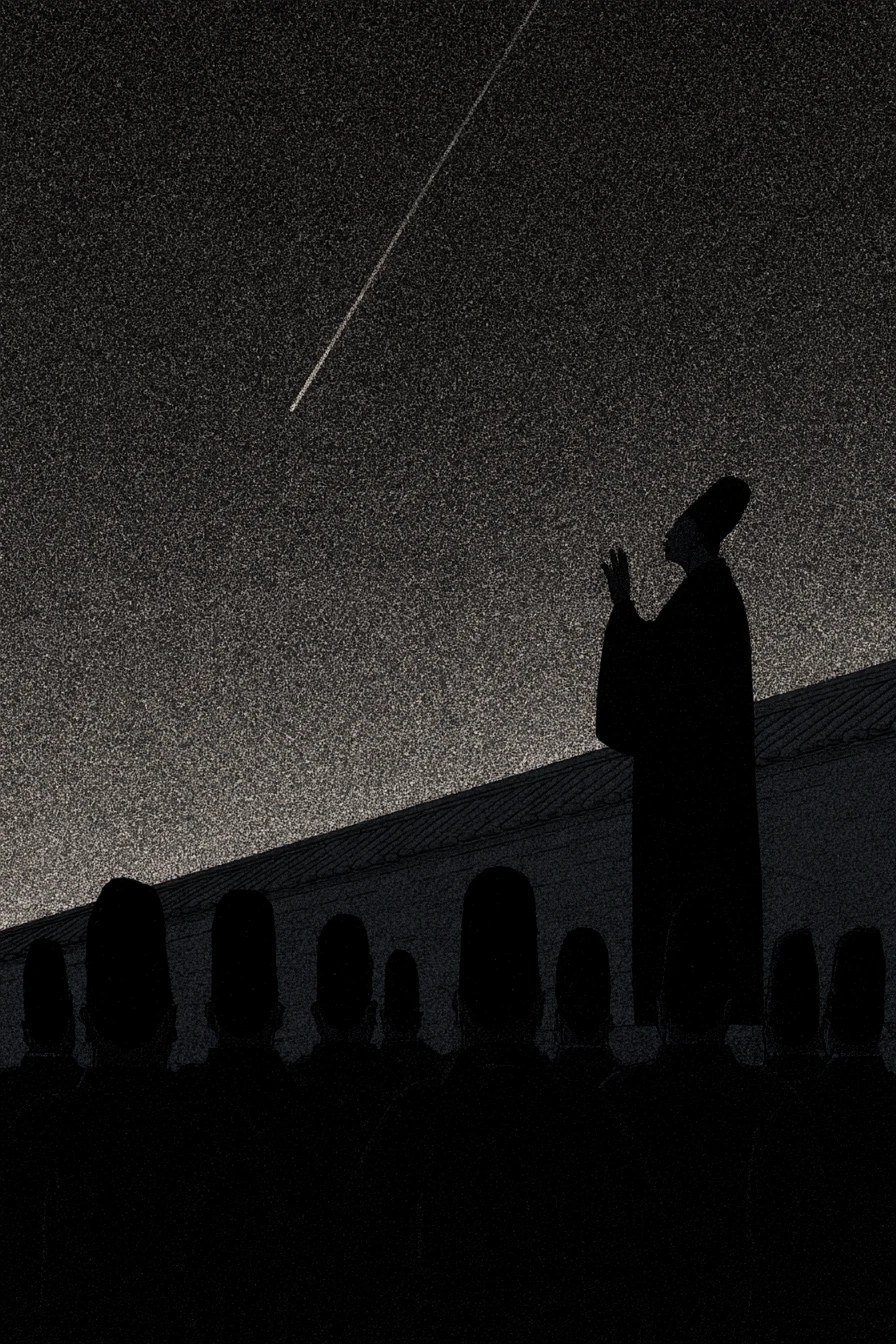
In the second month of the ninth year of Jomei, which is 637, the court chronicle records a great star that went from east to west with a sound like thunder.[1] People said it was the sound of a falling star. Others said it was thunder under the ground.
A monk named Min corrected them. It is not a falling star, he said. It is a tengu, and its bark only sounds like thunder.
That is the first appearance of the word in Japanese writing, and nothing in it is what an English reader expects. There is no bird, no mountain, no long nose, no red face. There is an astronomical event and a dispute about how to classify it.
Min was in a position to know what he meant. He had gone to China as a student in 608 and stayed twenty-four years, arriving under the Sui and returning, in 632, to a country that was now the Tang. What he brought back on this occasion was a Chinese category: tiangou, the celestial dog, a term used in Chinese astronomical writing for certain meteors. He was not identifying a monster. He was giving a technical name to something in the sky.
One further detail is worth keeping. The old Japanese reading attached to those two characters in the chronicle is not tengu at all. It is amatsukitsune. The first tengu in Japan was read aloud as heaven fox — a gloss the first English translator of the chronicle also recorded, in 1896.[2]
The Gap, and What It Is Worth
It is often said that the word then disappears from Japanese writing for about five hundred years, until it resurfaces in the tale literature of the twelfth century. I have not found any study that establishes this by an actual survey of the sources, and a claim of that shape needs one, so it is better treated as a received statement than a checked fact.
What is not in doubt is that when the tengu is next written about at length, it has changed completely. It lives in mountains, it flies, it takes the form of a kite or of a monk, and its entire business is interference with Buddhism.
The Import That Loses
The twentieth book of the Konjaku monogatarishū, compiled in the twelfth century, is largely given over to tengu.[3] Among its stories is one about a tengu who comes to Japan from China to test the power of the Japanese clergy and is comprehensively beaten.
That episode had a long life of its own. It became a picture scroll, the tale of Zegaibō, whose oldest surviving copy, made in 1354, carries a colophon recording that it was copied from an original of 1308.[4]
A creature that arrived in Japan under a Chinese name had, within a few hundred years, acquired a story about a Chinese tengu arriving and being defeated. The import was naturalized so thoroughly that it could be xenophobic about itself.
The Mountain Habit
At some point the tengu put on the robes, the small cap and the conch of the yamabushi, the mountain ascetic, and that is how it has been drawn ever since. I would like to give a date for this and cannot. The secondary literature offers the association as obvious and does not identify where it is first attested, and I have not been able to establish a first text.
One indirect trace is suggestive. The great tengu are known by names ending in -bō, the word for a monk’s quarters: Sōjōbō of Mount Kurama, Tarōbō of Mount Atago. A nineteenth-century compiler records the folk explanation that the names were simply taken over from the dwellings of the mountain ascetics who lived on those peaks.[5] Whether or not that is the true etymology, it shows people in the Edo period assuming that the tengu’s mountains were the ascetics’ mountains.
Forty-Eight Named Offices
By the middle of the Edo period the tengu had something no other creature in this literature has: a register.
The Tengukyō is not a sutra but a prayer text, used by mountain practitioners, which opens by addressing the great tengu and the small tengu together and then names forty-eight great tengu, each with his mountain — Tarōbō of Atago, Sōjōbō of Kurama, Saburō of Izuna, and forty-five more.[6]
Something that began as an unexplained noise in the sky ends as an organizational chart.
The Argument of 1896
The last scene in this sequence is a disagreement between two scholars, and it is the reason I wanted to write about the tengu at all.
Oyamada Tomokiyo, a scholar of the national learning working in the first half of the nineteenth century, had argued in his notebooks that the izuna rite — a practice usually understood as the worship of a fox — is in fact addressed to a tengu, and cited the Noh play Kurama-tengu in support.[7]
In his lectures on yōkai delivered in 1896, the philosopher Inoue Enryō quoted this and refused it. The Kurama-tengu libretto, he wrote, is hard to establish as certain evidence.[8]
That is a small sentence, and it is the whole discipline in one line. A play is a play. It shows what people found plausible when it was written, and that is not the same as showing what a rite was for.
There is a last irony in it. The two scholars are arguing about whether a rite belongs to a fox or to a tengu — and the first time the word was written down in Japan, more than a thousand years earlier, it was read aloud as heaven fox.
What Has Actually Been Continuous
One reading is that the tengu evolved: a meteor became a demon, a demon became an ascetic, an ascetic became a mascot. The record reads more like a name being reassigned.
The face itself has never been settled. Scholars still disagree about when the long-nosed tengu replaced the beaked one — some put the change in the late Kamakura period, others in the Muromachi — and they disagree just as sharply about where the nose came from, whether from a mask tradition or as a remnant of the beak. There is no consensus to report, and it would be easy, and wrong, to write as if there were.
What has been continuous is two characters that a returning student used in 637 to explain a sound, and which have been available ever since to anyone who needed a name for something in the mountains.
Sources
- Nihon shoki 日本書紀, 720; ninth year of Jomei, second month. Commons
- The reading amatsukitsune 天つ狐 follows the Kitano manuscript’s gloss; it is noted in W. G. Aston’s translation of the chronicle, 1896.
- Konjaku monogatarishū 今昔物語集, 12th century, book twenty. Wikipedia
- Zegaibō e 是害房絵, picture scroll; oldest surviving copy dated 1354, its colophon giving 1308 for the original.
- Matsunoya gaishū 松屋外集, notes and researches by Oyamada Tomokiyo 小山田与清 (1783–1847), compiled in the first half of the 19th century.
- Tengukyō 天狗経, prayer text of the mountain practitioners, mid-Edo period.
- Kurama-tengu 鞍馬天狗, Noh play, 15th century. Wikipedia
- Inoue Enryō 井上円了, Yōkaigaku kōgi 妖怪學講義, lectures of 1896. Wikipedia
Further Reading
- Haruko Wakabayashi, The Seven Tengu Scrolls: Evil and the Rhetoric of Legitimacy in Medieval Japanese Buddhism, University of Hawai’i Press, 2012
- M. W. de Visser, “The Tengu,” Transactions of the Asiatic Society of Japan 36, 1908
- Carmen Blacker, The Catalpa Bow: A Study of Shamanistic Practices in Japan, 1975
The reading in “What Has Actually Been Continuous” is KWAIDANOTE’s own.
Found an error? Write to kwaidanote@gmail.com — corrections are made on this page and dated.