The Kappa Gives Its Word
The Creature in the Encyclopaedia
The description that almost every later Japanese book copies comes from an illustrated encyclopaedia compiled by the physician Terashima Ryōan and printed in 1712. Its entry is on the kawatarō, the river boy, and it reads as field notes rather than folklore.[1]
There are many of them, it says, in the valleys, ponds and rivers of Kyushu. They are shaped like children of about ten. They go naked, stand and walk well, and speak. Their hair is short and sparse. The crown of the head is hollow, and will hold a handful of water. They live in the water and come out along the banks at evening to steal melons, aubergines and field grain.
They like wrestling. Seeing a person, a kawatarō will beckon and ask for a bout. The way to beat one is to bow first: bow, and it bows back, and the water runs out of the hollow in its head, and its strength goes with it. If the water stays in, it is twice as strong as a strong man. Its arms, the entry adds, pass straight through from one side to the other, so that pulling one only draws the other in, and there is nothing to be done. And it will drag oxen and horses into the deep bends and drain the blood from them.
Two later compilations quote this passage; I checked them against each other and they agree word for word, which is some comfort in a subject where quotation is the rule.
Almost everything the English-speaking world associates with the kappa is here in 1712 — the hollow head, the wrestling, the taste for melons, the horses. What is not in the English picture is what the rest of the record is mostly about.
The Arm as Collateral
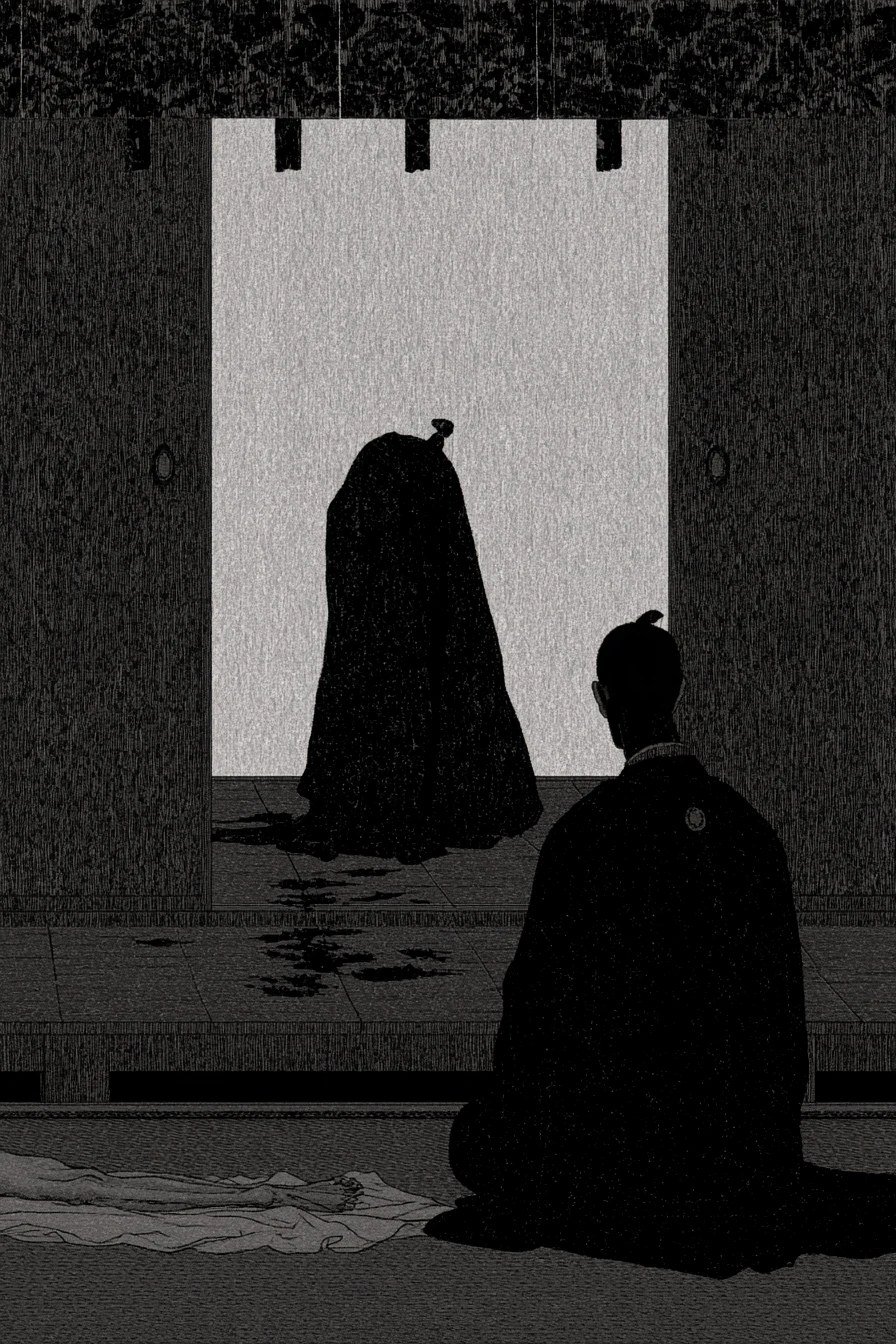
In Fukuoka a domain physician named Takatori Unshōan had a wife who felt a hand take hold of her in the privy and cut it off at a stroke. That night a kappa came under the window and begged for the arm. Unshōan’s price was instruction: teach me bone-setting. The kappa taught it to him from the other side of the paper screen, without showing itself, and the family kept the method afterwards as a secret passed to one heir at a time.[2]
In Izu an army physician in the service of Takeda Shingen was fording a river when a long yellow arm took his horse’s leg, and he cut it off. The kappa came to him that night in a dream and offered a formula for a wound medicine in exchange for the arm. He woke to find the arm gone from beside his pillow and wet prints on the veranda. The medicine worked. He called it kappa medicine, settled at Kumogane, and his descendants went on making it under the name of the place.[3]
In Higo a child was taken from the river at Ishihara, and the local lord Ishihara Kanosuke went into the water himself, wrestled the kappa and tore its arm off. That night the kappa came to his house to apologize, and bought its own arm back with a promise never again to harm anyone of that village.[4]
Three stories, from three provinces, with one structure. The arm is held. The kappa does not fight for it or steal it back. It negotiates, and what it pays with is either knowledge or a promise.
Written Terms, and a Date in the Calendar
The promise is sometimes said to have been written down.
A gazetteer of the old province of Nagato lies behind a story of a kappa caught in a horse’s feed trough at Manokura, after it had tried to drag the animal into the water. It pleaded for its life and produced a written bond: so long as this stone stands, none of our kind will do harm within this village. What survives is not the document but the stone, still called the ape-stone, and the tradition attached to it.[5] Elsewhere the object is the thing that remains — a coin, given in gratitude by a kappa child to a sweet-seller in Edo, was recorded as still being kept in a named household.[6]
The terms are often specific, and so are the dates. In Tosa, villagers below Godaisan spared a kappa that had gone for a horse, on conditions covering not only people but cattle, horses, chickens and dogs; in return the village undertook a kappa rite every year on the fifteenth day of the sixth month. Two separate compilations record that village and that date, each citing a different earlier source.[7]
In the Kuma district of Kyushu the first day of the second month is called Tarō’s first day, and is the day the mountain tarō and the river tarō change places. In a village in Hyūga the kappa was said to come down to the settlements at the spring equinox and return to the mountain at the autumn one.[8]
A creature with negotiated terms, a payment schedule and a date of seasonal transfer is not really a monster. It is a neighbouring party.
The Scholar Who Refused to Settle It
By the end of the nineteenth century the philosopher Inoue Enryō had devoted a whole section of his study of yōkai to the kappa, and his handling of it is a small model of how to treat this material.[9]
He quotes the older opinions rather than paraphrasing them. A discussion book of 1686 had proposed that the kawatarō is an otter grown old and gained in power, reasoning from the otter’s habit of laying out fish as if making an offering. Another book asserted that the thing in the water is mostly snakes, and that the opened body and damaged front teeth of a drowned person are the traces of one.
Enryō rejects the last of these on physical grounds: the drowning is cramp, and the state of the body is decomposition. His own view is that the kappa belief probably began with softshell turtles and water snakes that did in fact harm people. He then adds two more layers that have nothing to do with animals. A person raised on kappa stories, seeing something indistinct in the water, will identify it immediately as a kappa. And adults, he notes, have deliberately manufactured kappa — stories and even figures placed in the water — to keep children away from the river.
Then he stops and writes that this is only his own conjecture, and that he must wait for the judgement of those who know better.
What the Bargains Were About
One reading of the kappa is that it is a drowning with a face on it. The agreements suggest something more exact than that.
Look at what the treaties actually cover. Children at the water’s edge. Horses at the ford. Cattle brought down to drink. Chickens and dogs near the bank. Every clause in every pledge in the record names something that really does die in a river, and the rite is set for the fifteenth of the sixth month, in the season when people are most often in the water.
A village that had terms with the kappa had a river it could hold to an agreement. That is a considerable thing to have, and a good deal more useful than a monster.
Sources
- Wakan sansai zue 和漢三才図会, illustrated encyclopaedia compiled by Terashima Ryōan 寺島良安, 1712; the kawatarō 川太郎 entry. Commons
- Kyūshū no densetsu 九州の伝説, as cited in a survey of Japanese customs; the physician Takatori Unshōan 鷹取運松庵.
- Izu densetsu shū 伊豆伝説集; the wound medicine of Kumogane 雲金.
- Nihon densetsu shū 日本伝説集; Ishihara Kanosuke 石原叶之助 of Higo.
- Nagato no kuni fudoki 長門国風土記, book three, as cited in a dictionary of Japanese folklore; the ape-stone at Manokura 萬倉.
- Ichiwa ichigen 一話一言, book three; the kappa’s coin.
- Santō mindanshū 山島民譚集, by Yanagita Kunio 柳田國男, 1914; and Doshū enkakushi 土州淵岳志, book six.
- Kyōdo kenkyū 郷土研究, volume four, number two, for Tarō’s first day; and a collection of the traditions of Magenta in Hyūga for the equinox reckoning.
- Inoue Enryō 井上円了, Yōkaigaku 妖怪学; the section on the kappa, which quotes Kokon hyakumonogatari hyōban 古今百物語評判, book four. Commons
Further Reading
- Orikuchi Shinobu 折口信夫, “On the kappa,” in his studies in folklore, 1929
- Michael Dylan Foster, The Book of Yōkai: Mysterious Creatures of Japanese Folklore, 2015
The reading in “What the Bargains Were About” is KWAIDANOTE’s own.
Found an error? Write to kwaidanote@gmail.com — corrections are made on this page and dated.