What Came Out of the Tail
The Blade That Would Not Cut
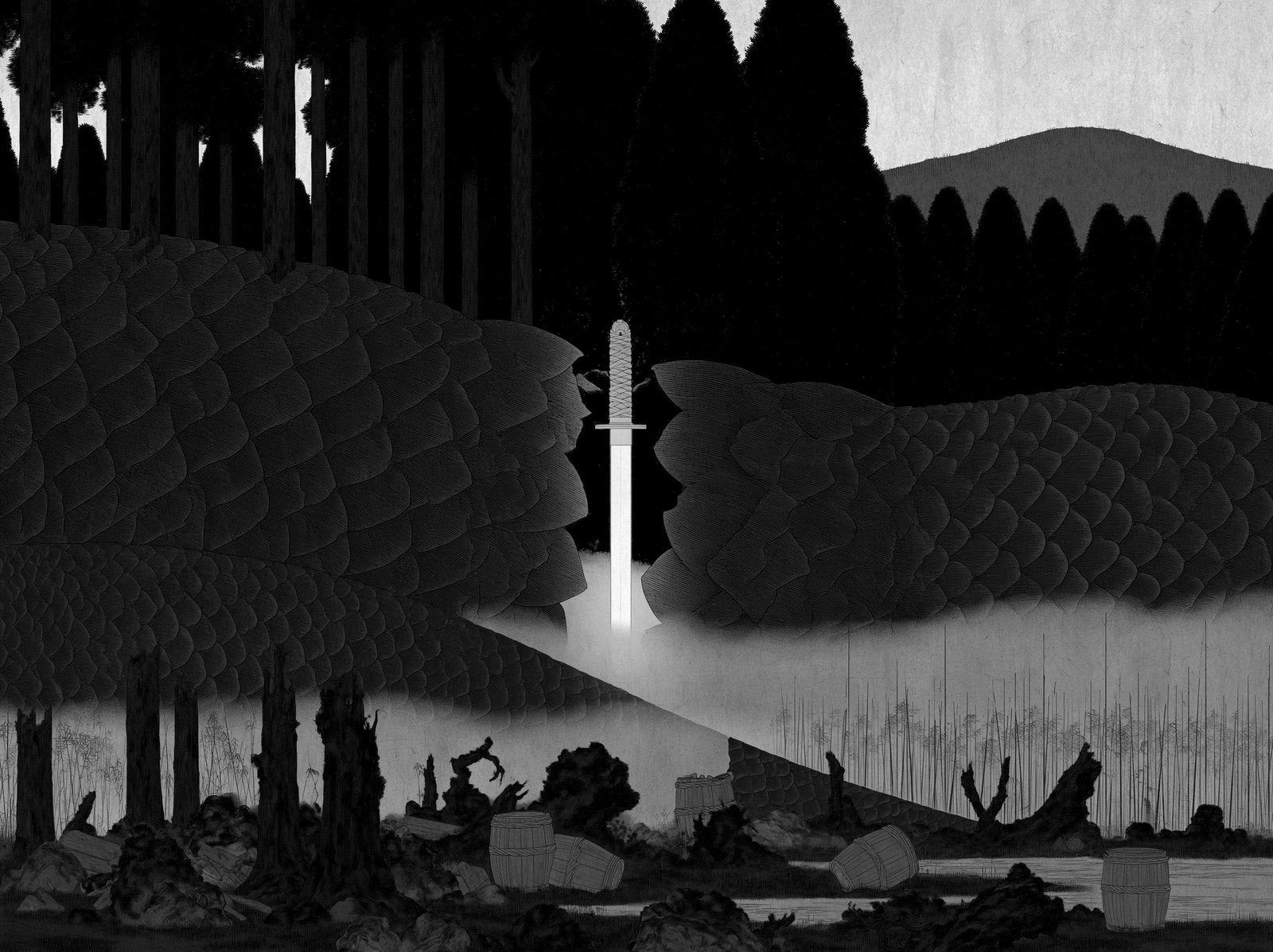
The serpent is already dying when the interesting thing happens. Susanoo has been working through it with his sword, head by head and then along the body, and when he reaches the tail the blade chips.
He cuts the tail open lengthwise. Inside is another sword.
That moment is the reason the episode is in the chronicles at all. Everything before it — the weeping family, the drink, the eight heads lowering into eight vats — is the machinery that produces an object, and the object outlasts the story by twelve centuries and is still named among the imperial regalia.
Two Books, Two Spellings
The episode survives in the two eighth-century chronicles, and they do not agree even about how to write the creature’s name. The Kojiki of 712 writes it 八俣遠呂智; the Nihon shoki of 720 writes it 八岐大蛇.[1][2]
The disagreements run through the details. The girl is Kushinada-hime 櫛名田比売 in one and Kushiinada-hime 奇稲田姫 in the other. The drink is described differently. The sword found in the tail has a name in the Kojiki that the Nihon shoki does not use.
The Nihon shoki goes further. It sets out alternative versions side by side, introduced with the formula “in one writing it is said,” and the alternatives disagree with each other: about which province the encounter happens in, about the names of the girl’s parents, about who exactly the girl is.
Its compilers had several accounts in front of them and printed more than one instead of choosing. A book assembled by a government in 720 is more willing to leave the question open than most retellings written since. That is worth holding onto whenever a modern version presents the episode as a single fixed text with a single correct set of names.
The Drink
The Kojiki calls what the family brews yashiori no sake 八塩折の酒. The term describes a method: brew the liquor, press it, and then use that liquid in place of water to brew again, and repeat. Eight here is the usual old Japanese way of saying many rather than a count.
So the eight vats do not hold eight servings of ordinary rice wine. They hold something that has been concentrated over and over specifically for this purpose. The trap is not that the serpent drinks; it is that the drink has been built.
The Girl Is a Rice Field
Kushinada-hime’s name is generally read as the sacred, or wondrous, rice paddy. Both chronicles spell it with characters that carry that sense, and the second spelling puts the word for rice-seedling directly into it.
Susanoo does not hide her. He turns her into a comb and puts her in his hair, and she is on his head throughout the fight. When it is over she is restored.
It is a strange piece of staging, and it is also the clearest signal in the episode about what is being fought over. The thing rescued from the serpent is named for the crop.
The Sword and Its Three Names
What comes out of the tail is called, in the Kojiki, Tsumugari no tachi — a name built on a verb for reaping. That name appears in the Kojiki and not in the other chronicle.
Both texts then give it the name it is better known by at this stage, Ame-no-murakumo, the sword of the gathering clouds. Susanoo does not keep it. He sends it up to the sun goddess, and it passes out of this story into the imperial line.
Its third name comes much later and from a different episode altogether: Kusanagi, the grass-cutter, from the tale of Yamato-takeru and a burning field. An object that changed its name twice as it moved through the record is the only thing in this story still treated as real.
What People Have Read Into It
Two readings recur, and neither is settled.
The first takes the serpent for the Hii river, which runs through the Izumo region where the episode is set and which flooded. Eight heads and eight tails become the branching of a watercourse; defeating it becomes flood control.
The second takes it for iron. The Izumo region worked iron sand, and this reading finds the smelter in the serpent’s red eyes, the ore-stained water in the blood that reddens the river, and the industry’s product in the blade from the tail.
Both are attractive, and both have been argued seriously without becoming the standard account. What is worth noticing is that the two readings share a shape: something in the uplands damages the valley below, and mastering it yields something valuable. That is a reading of the readings, not a finding, and the chronicles support neither directly.
The local geography has been mapped onto the story too — particular mountains, particular stretches of the Hii — but that identification is later tradition rather than anything the eighth-century texts fix.
Killed in the Middle
Among the serpents in the old Japanese record, this one is unusual twice over. It is killed, and the killing is not the end of the episode.
Most serpent stories in these traditions end when the serpent is dealt with. Here the death is the midpoint. What follows is a marriage, a house built at a place named in the text, a poem, and the delivery of a sword to a goddess — the establishment of things that continue. The monster is an obstacle in a founding narrative, not the subject of one.
That is a plainer role than later Japanese serpents get, and it explains why this episode reads less like a ghost story than like a deed of title.
It also explains the one detail everybody remembers. The heads are the picture; the tail is the point. A story about a monster would have ended when the monster stopped moving. This one keeps going for as long as it takes to get the object out, name it, and send it somewhere it will be kept — and the place it was sent is still, twelve hundred years later, the reason the object has a name at all.
Sources
- Kojiki 古事記, compiled 712. Upper volume, the Susanoo sequence. Wikimedia Commons
- Nihon shoki 日本書紀, compiled 720. Book one, the Age of the Gods. Wikimedia Commons
Further Reading
- Basil Hall Chamberlain, translator, Ko-ji-ki: Records of Ancient Matters, 1882
- Donald L. Philippi, translator, Kojiki, 1969
- Gustav Heldt, translator, The Kojiki: An Account of Ancient Matters, 2014
The reading in “What People Have Read Into It” and in “Killed in the Middle” is KWAIDANOTE’s own.
Found an error? Write to kwaidanote@gmail.com — corrections are made on this page and dated.