The Snow Woman Is Not in the Old Books
The Story in English
The snow woman most English readers know comes from one book. In Lafcadio Hearn’s Kwaidan of 1904, two woodcutters are caught by a blizzard; the younger one wakes to see a woman in white breathing frost over the older man, who dies; she spares the boy on condition that he never speak of it. Years later he marries a woman called O-Yuki, they have ten children, and one winter evening he tells her about the night in the hut. She is the woman in white. She leaves, and does not kill him, because of the children.
Hearn said where he got it. In his prefatory note he wrote that “One queer tale, ‘Yuki-Onna,’ was told me by a farmer of Chōfu, Nishitama-gōri, in Musashi province, as a legend of his native village.”[1]
That single sentence has carried the whole subject in English for over a century. It is worth asking what stands behind it, and the honest answer turns out to be more interesting than either “ancient folklore” or “Hearn made it up.”
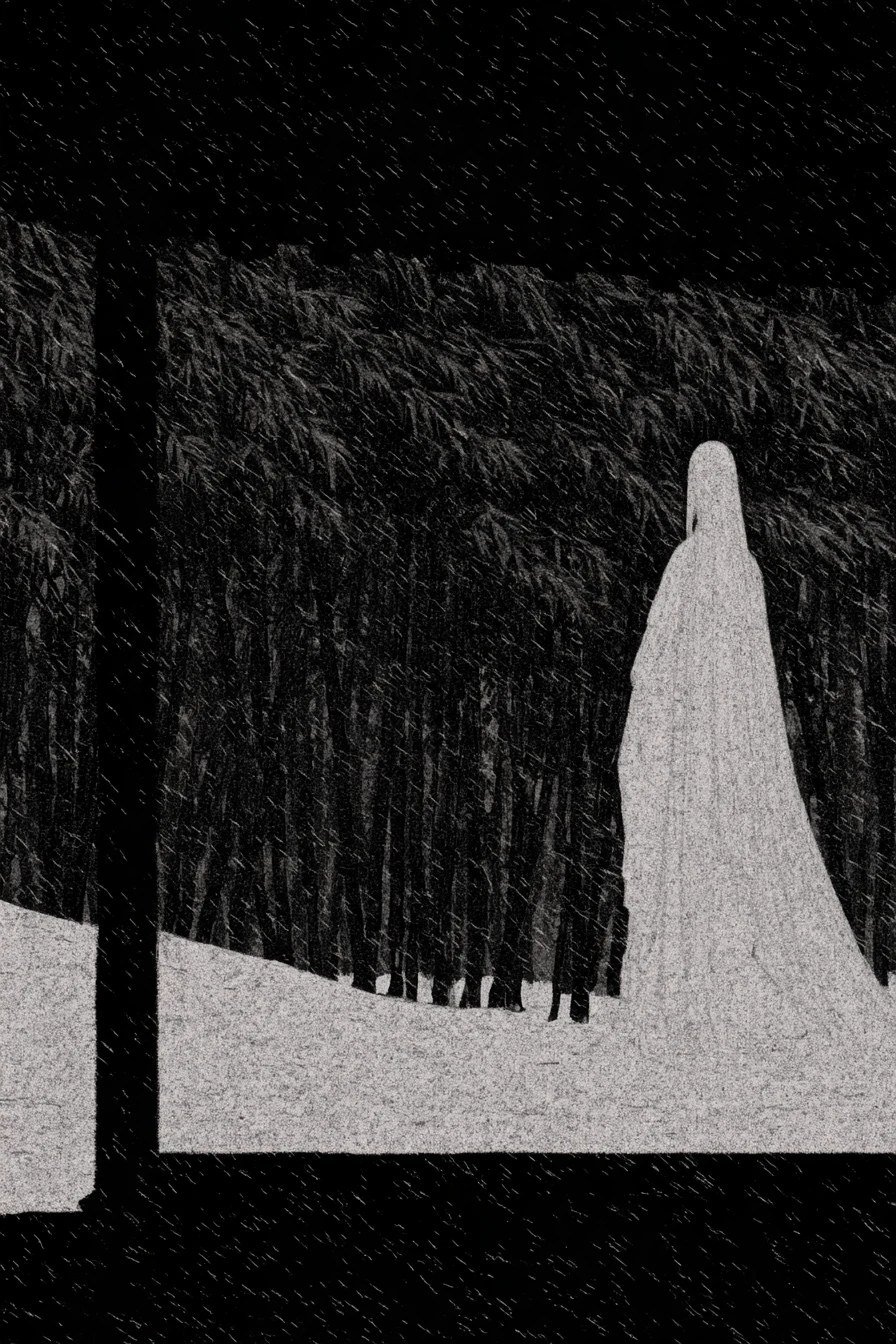
A Man in 1686 Asks the Same Question
More than two hundred years before Hearn, a writer had already gone looking for the snow woman in older books, and reported what he found.
Kokon hyakumonogatari hyōban is a set of discussions of strange stories, written by Yamaoka Genrin and printed in 1686 — fourteen years after his death, from papers put in order by his son.[2] It is not a collection of ghost stories. It is a book that takes ghost stories and argues with them, mostly along the lines of yin and yang.
Its seventh discussion in the fourth volume is on the snow woman, and it opens from an odd direction: someone observes that the word has lately been turning up in haikai verse. The answer given is blunt. The thing called yuki-onna is not to be found in the old books of Japan or of China, and in composing verse one should not write of such things as though one had certainly seen them.
That is a seventeenth-century writer saying, in effect, that the snow woman is a poetic fashion without a pedigree.
What He Says Next Is Better
He does not then dismiss her. He reasons that where water is deep, fish come to be in it; where woods grow thick, birds come to be in them; where any substance gathers in quantity, living things arise within it. And so, he concludes, in the snows of Koshiji — the old snow country along the Japan Sea — it cannot be measured whether such a thing might appear. As for the name: snow belongs to the yin, and so does woman, and that is likely why she is called what she is called.
A rationalist of 1686 leaves the door open. I find this the most attractive moment in the whole record, because it is exactly the position the evidence still supports.
The Sightings That Do Exist
What the earlier material gives is not a plot but a sighting.
A miscellany of strange tales known to us through a later scholar’s quotation describes a traveller lost in deep snow in the north in the tenth month, who sees white figures standing out in the fields at dusk. His host at the village lodging tells him that this is the yuki-onna, that the snow lies very deep in that country and she is seen from time to time, and that when spring comes and the snow melts she is at some point simply gone.[3] Nobody is killed. Nobody marries anyone.
A collection of about 1685 has the renga poet Sōgi, during a long stay in Echigo, see at dawn a woman in white of enormous height beside a bamboo grove, who moves into the garden and is not there.[4] This is often described as the earliest prose account of the snow woman, though the claim is repeated more often than it is sourced.
When Toriyama Sekien put her into his picture-book of monsters in 1776, he did what that book does with most of its entries: he gave her a figure and a name, and almost nothing else.[5]
Local tradition, collected later, is more varied than any of this and less like Hearn. In the north she may be a woman who asks a traveller to hold her child. She may be an icicle who takes a husband and dissolves when he insists she bathe. She may freeze a man, or call to him from a ravine until he answers and falls. She has different names in different valleys.
The Book That Does Not Mention Her
There is one piece of evidence that is usually left out, and it cuts against the idea of a deep unbroken tradition.
Hokuetsu seppu, issued in parts from 1837, is the great book of the snow country — a long, closely observed account of life under the heaviest snows in Japan, written by a man who lived there.[6] It has no snow woman in it.
What Hearn Actually Contributed
Japanese scholarship on this question is fairly settled, and it is not flattering to the romantic version. Attempts to trace Hearn’s plot — the rescue, the promise of silence, the marriage, the disclosure, the departure — backwards past his own time do not find it. The earlier material gives apparitions, not that story. Hearn’s farmer at Chōfu has never been identified, and his claim cannot be checked.
Then comes the part that makes the whole case worth writing about. Versions closely matching Hearn’s plot do turn up in the field — collected in Shinshū, in Tōno and elsewhere, from the 1930s onward. The scholars who work on this take the obvious view: the story went out from the book and into the villages, and a generation later it was being told back to collectors as local tradition.[7]
Hearn said a farmer told it to him. Within thirty years of his death, farmers were telling it.
Where That Leaves Her
One reading is that this makes the snow woman modern, and that the tradition is thinner than it looks. That is not quite right either. The word was already common enough in 1686 to irritate a critic. Women in white were being seen in the snow, and being explained, long before anyone gave them a marriage plot.
What is genuinely old is the sighting and the argument about it. What is recent is the story — first as a book, then, remarkably, as folklore.
Genrin’s question has not been answered in three hundred and forty years. He asked where she came from, could not find her in the old writing, and decided that deep snow might produce her anyway. Given the record, that remains a reasonable position.
Sources
- Lafcadio Hearn, Kwaidan: Stories and Studies of Strange Things, 1904; prefatory note. Commons
- Kokon hyakumonogatari hyōban 古今百物語評判, by Yamaoka Genrin 山岡元隣 (1631–1672), printed 1686; book four, seventh discussion, “On the snow woman, with a discourse on snow.” Wikipedia
- Wakan kaidan hyōrin 和漢怪談評林, a miscellany of strange tales, known here through its quotation in the yōkai studies of Inoue Enryō.
- Sōgi shokoku monogatari 宗祇諸国物語, c. 1685.
- Gazu hyakki yagyō 画図百鬼夜行, by Toriyama Sekien 鳥山石燕, 1776. Commons
- Hokuetsu seppu 北越雪譜, by Suzuki Bokushi 鈴木牧之, first part 1837, second 1841. Commons
- On the dating of the collected versions, see the study listed below.
Further Reading
- Makino Yōko 牧野陽子, “On the original tale of ‘Yuki-Onna’,” 1989
- Michael Dylan Foster, The Book of Yōkai: Mysterious Creatures of Japanese Folklore, 2015
The reading in “Where That Leaves Her” is KWAIDANOTE’s own.
Found an error? Write to kwaidanote@gmail.com — corrections are made on this page and dated.