The Stone Has Split Before
A Rock in the News
On 5 March 2022 a volcanic boulder in the Nasu highlands of Tochigi prefecture was found to have split open. Photographs travelled the world within a fortnight. English-language coverage settled fast on a single sentence: the killing stone had broken, and the evil nine-tailed fox sealed inside it for nine hundred years was loose. CNN ran it. So did most of the aggregators, one of them promising readers that a 900-year-old spirit was on the loose.
Nearly every element of that sentence can be dated, and the dates are not the ones implied.
What the Stone Is Supposed to Be
The legend, in the shape most Japanese readers know, runs like this. A woman of extraordinary beauty and learning appears at the twelfth-century court. The retired emperor Toba falls ill; a diviner exposes her as a fox; she flees to the moor at Nasu, is hunted down and shot, and her body becomes a stone that kills whatever comes near it. Long afterwards a priest confronts the stone and releases what is in it.
Every stage of that has a first appearance in writing, and they are centuries apart.
The Oldest Ending Is a Broken Stone
The Noh play Sesshōseki, from the fifteenth century, is the earliest telling most people meet.[1] In it the spirit appears to the priest Gennō on the moor, recites her history, and is released by his rite. The play does not break the stone. It converts it.
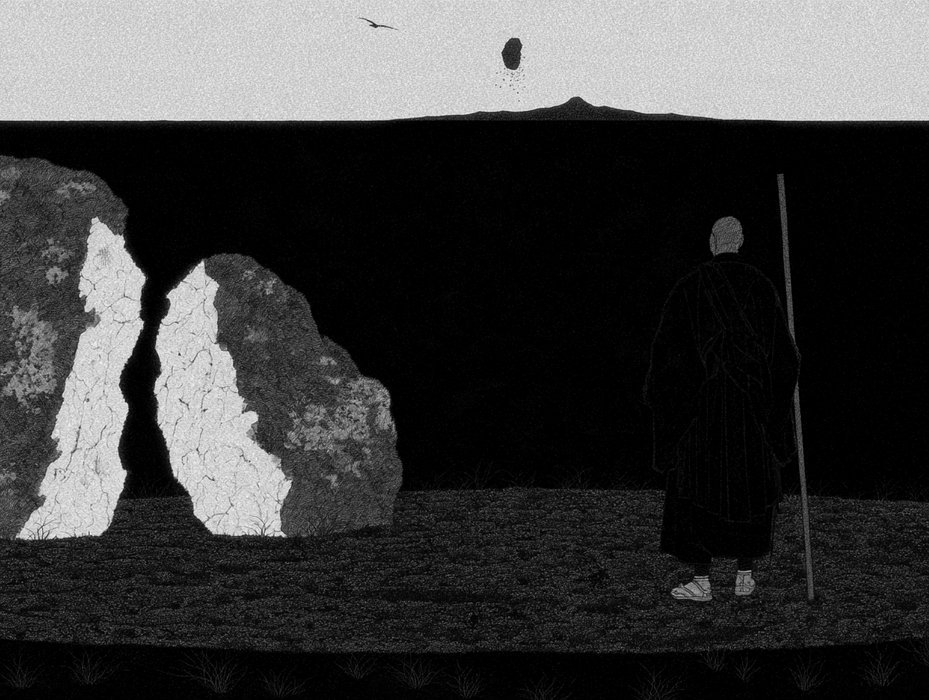
The shattering belongs to the tradition that grew around the priest himself. An account of his life compiled in 1429 has the stone burst into three pieces that fly apart to separate places, one of them landing at a temple that afterwards took its mountain-name from the fragment. Where the third piece went, that account does not say.[2] By the late eighteenth century a travel writer could report the breaking to his readers as a settled fact of the site, with a year attached.[3]
So a split killing stone is not a rupture in the tradition. It is how the tradition ends. The hammer called a gennō in Japanese carpentry is popularly said to be named for the priest who used one here — a folk etymology rather than a documented one, but a fair measure of how firmly the breaking is attached to his name.
The Nine Tails Are the Newest Part
Our earlier note on foxes observed that the version of this legend our own volume follows gives the fox no particular number of tails. That is not a quirk of one text.
The Muromachi picture-book Tamamo no sōshi describes a fox eight thousand years old and seven feet long, with two tails.[4] The Noh play does supply the three-country career — a demon in India, a queen in China, Tamamo at the Japanese court — so that frame is medieval and not an Edo invention. But the Chinese predecessor the play names is Bao Si, consort of King You of Zhou. Not Daji.
Daji and the nine tails arrive later, and from elsewhere. The nine-tailed fox of the Engishiki, the tenth-century code of court procedure, is an auspicious omen, a divine beast.[5] Its career as a monster comes out of Chinese commentary, which reached Japan by the early twelfth century in a short treatise on fox seduction that reports Daji of the Yin as a nine-tailed fox.[6] The two streams join in the Edo period: a Buddhist tract of 1766 is the earliest text known to give Tamamo the gold-furred nine-tailed shape, and the version everyone now tells — India, then China as Daji, then Japan, nine tails throughout — is completed in two illustrated books published between 1803 and 1805.[7]
That is about four hundred years after the legend first appears in writing, and a little over two hundred years before the boulder cracked. The fox in the 2022 headlines is a late-Edo fox. I have not found an English report from that spring that gave the nine tails any date at all.
What the Town Actually Said
Here the coverage inverted the situation it thought it was describing.
The Nasu tourist association’s announcement, issued on 23 March 2022, did not explain the crack. It announced a memorial service and a prayer for peace at the site three days later, and it framed the break in the language of the legend itself — an auspicious divine beast revived, a good omen for the end of the pandemic and for peace in the world. The institution told the legend; the newspapers supplied the physics. The freeze-and-thaw explanation that circulated so widely is a view attributed to the town in press reports, not the content of the announcement.
The stone’s official status is also not what is usually stated. It is not a designated historic site. On 18 March 2014 it became a national Place of Scenic Beauty, as one component of a group listing called the Scenic Sites of Oku no Hosomichi. It is protected, in other words, because Bashō went there.
The Part That Is Not Legend
Bashō did go there, in the summer of 1689, and what he wrote is the one element of this that needs no qualification. He records that the poison of the stone had not yet faded, and that bees and butterflies lay dead in such numbers that the colour of the sand beneath them could not be seen.[8]
That is not a flourish. Nasu-Yumoto sits on an active volcanic field, and the hollow the stone lies in vents hydrogen sulphide. The walkway is closed to visitors when output is high, and animals are still found dead around it.
The killing in “killing stone” is the documented part. The fox is the part that keeps being revised.
What a Signboard Is For
The town’s own visitor page tells the story straight: a beautiful consort who was really a nine-tailed fox, flown in from India by way of China. It does not mention that the version it is telling was assembled around 1804, because that is not what a signboard is for. A signboard’s job is to make a visitor stand still in front of a rock.
The reporting is a different matter. What went around the world in 2022 was a legend’s most recent draft, presented as its oldest, with a round number of years attached to a detail that had not existed for most of them. The correction is not that the story is false. It is that the story has a history, and the history is the better story: a two-tailed fox out of a picture book, a Chinese queen who was originally a different queen, a priest whose name became a hammer, and a rock that has been breaking, in one telling or another, for six hundred years.
Sources
- Sesshōseki 殺生石, Noh play, 15th century; attributed by one tradition to Hiyoshi Sa’ami. The three-country passage naming Bao Si is in the spirit’s own recitation.
- Record of the acts of the priest Gennō Shinshō 源翁心昭, compiled 1429.
- Tōyū zakki 東遊雑記, travel account by Furukawa Koshōken, late 18th century. Cited here at second hand; the original has not been consulted for this note.
- Tamamo no sōshi 玉藻の草子, otogizōshi tale, Muromachi period. Commons
- Engishiki 延喜式, code of court procedure, completed 927. Commons
- Kobiki 狐媚記, by Ōe no Masafusa, 1101.
- Kanke byakko tsū 勧化白狐通, 1766; Ehon sangoku yōfuden 絵本三国妖婦伝 by Takai Ranzan, 1803–1805; Ehon tamamo-tan 画本玉藻譚, 1805.
- Oku no hosomichi おくのほそ道, Matsuo Bashō, journey of 1689. Commons
Also used: the Nasu tourist association’s announcement of 23 March 2022, and the town of Nasu’s own designation and visitor pages.
Further Reading
- Ian S. Ferguson, The Evolution of a Legend: A Comparison of the Character of Tamamo no Mae Portrayed in Muromachi Period Otogizōshi and in the Late-Edo Vendetta Tale, University of Colorado at Boulder, 2012
- Andreas Marks, Japanese Yokai and Other Supernatural Beings, 2023
The dating of the nine-tailed form follows published Japanese scholarship; the reading in the closing section is KWAIDANOTE’s own.
Found an error? Write to kwaidanote@gmail.com — corrections are made on this page and dated.