What Is a Yōkai?
An Event, Not a Creature
In the third month of 777, the court ordered a great purification. The official history gives the reason in eight characters: strange things had been happening, repeatedly, inside the palace buildings. The word the compilers used for those strange things is the one now translated into English as monster, and printed on the covers of books about Japanese folklore creatures: yōkai 妖怪 [1].
Nothing in that entry has a face. There is no encounter and no description, no creature that came down a corridor. There is a run of anomalies serious enough that the state answered with ritual. The word named the situation, not a thing in it.
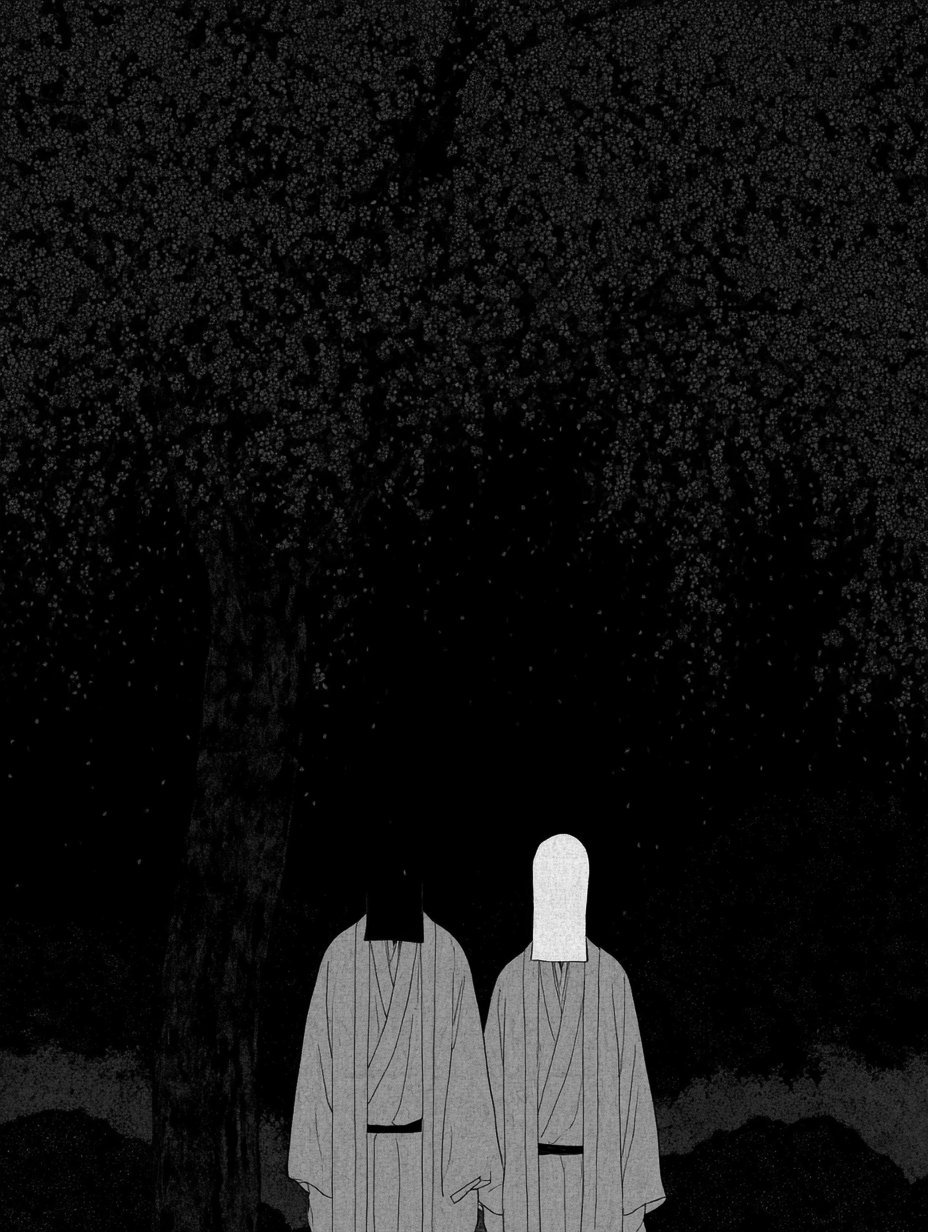
That is the earliest use of the word in Japan recorded by the standard historical dictionary, and it is worth holding onto, because almost everything the word has since been asked to do was added later.
Four Words, Four Different Jobs
Yōkai is a Sino-Japanese compound, read in the Chinese manner from the start. Its old kana spelling leads by regular sound change straight to today’s pronunciation. You will sometimes read that the characters were once pronounced mononoke; that confuses two separate words, and no dictionary supports it.
Mononoke 物の怪 is its own word, and in Heian writing it does something specific. It is what attaches itself to a person and makes that person ill — a spirit of the dead, or of someone still living, identified not by its appearance but by its effects and by what it takes to get rid of it. The most famous literary case, in the “Aoi” chapter of the Tale of Genji [2], is an affliction with a culprit, which is a different matter from a monster with a name.
Bakemono 化物 comes from the verb bakeru, to change shape: a thing that has changed. The dictionary’s earliest citation is from a tale of the late twelfth century [3], so it is not, as is often assumed, an Edo coinage — though the Edo period is when it became the everyday word.
Ayakashi あやかし is stranger still. Its oldest confirmed use is at sea: in a Noh text datable to around 1516, a retainer tells his lord that an ayakashi has fastened onto the ship [4].
These are not four names competing to label one class of being. Each names a relationship — an ominous event, an affliction, a change of form, a thing that attaches to a hull. The habit of treating them as rough synonyms belongs to a much later stage of the word’s life.
The Catalogue
Medieval picture scrolls of the night procession show crowds of creatures streaming across the paper: implements with limbs, animals upright, figures whose category is not obvious [5]. They are wonderful to look at. They are also, for anyone who wants to know what they are, useless. The scrolls carry no names and no captions. You can look at them; you cannot look anything up.
Toriyama Sekien (1712–1788) trained as a painter and worked in haikai circles, illustrating verse books. Between 1776 and 1784 he published four picture books of the strange [6][7][8][9]. The format is the thing: one creature to a frame, each with its name beside it, and from the second book onward a short explanatory text as well. A reader could now turn a page, find a figure, learn what it was called, and go looking for another.
The catalogue was the invention, not the creatures in it.
One of the entries makes the point sharply. Amikiri, the net-cutter, appears in Sekien with a name and a picture. Scholars who have gone looking for the folklore behind it have not found any: the name may be Sekien’s own, built out of wordplay, and a researcher who tried to trace the regional story it supposedly came from could not corroborate that story from any other source. What I find worth sitting with is the order of events. The picture and the name came first. A name in a catalogue can arrive before the belief it appears to record.
Two Men, One Word
By the end of the nineteenth century the word had acquired a use nobody in 777 would have recognized: it had become a problem to be solved.
Inoue Enryō (1858–1919) was a philosopher and educator who lectured on yōkaigaku — yōkai studies — across the academic year 1893–94, publishing the lectures in six volumes in 1896 [10]. He is known in scholarship as Dr. Yōkai, and his purpose was demolition. He had, by his own account, worked through several hundred varieties of reported strangeness in order to account for them and be done with them.
His sorting is more interesting than that purpose suggests. He divided reported marvels first into the false and the real. The false split into things people had faked and things people had simply misread. The real split again: on one side, phenomena that science could explain once you knew enough; on the other, a category he called shinkai, the genuinely unaccountable. The man who set out to explain yōkai away kept a compartment for what would not come apart.
Yanagita Kunio (1875–1962) took the word in the opposite direction. His Yōkai dangi of 1956 gathers essays written across nearly thirty years [11]. Its governing idea, stated as early as 1917, is that yōkai are gods who came down in the world: when older beliefs were displaced, the deities attached to them were demoted, and what remained were, in his phrase, unauthorized gods [12]. He also proposed a clean separation between yōkai and the ghosts of particular dead people, sorting them by where they appear, whom they come for, and at what hour.
Both ideas have been worked over since. Later folklorists testing the god-to-yōkai descent against fieldwork have found the traffic runs both ways, and the tidy yōkai-versus-ghost distinction does not survive contact with actual cases. This site has a separate note on what a yūrei is, and it does not much resemble a category.
The contrast between the two men is the useful part. One studied yōkai in order to be rid of them, the other in order to keep them, and both needed the same word to do it.
What the Word Carries Now
Japanese scholarship today tends to treat two terms as a pair: kaii 怪異, the strange event, and yōkai, the strange being. The national research database is named for both, which is an accurate piece of naming — it keeps the 777 sense and the Sekien sense in the same title rather than choosing between them.
In English the word has spread further still. It is applied to a disturbance in a palace, to an illness with a culprit, to a fox that changes shape, to something fastened under a ship, to a captioned print, and to the mascot of a town promoting its tourism. These have almost nothing in common except the label.
That is not a failure of the word. Each time someone has needed it for a new job — a court clerk, a print publisher, a philosopher clearing away superstition, a folklorist trying to save something — it has been available, and it has taken the new job on without giving up the old ones. A definition that fits one of those centuries will not fit the next.
Sources
- Shoku Nihongi 続日本紀, compiled 797. Book 34, third month of Hōki 8 (777). Wikimedia Commons
- Genji monogatari 源氏物語, Murasaki Shikibu, early 11th century. “Aoi” 葵 chapter. Wikimedia Commons
- Ariake no wakare 有明の別れ, late 12th century. Wikipedia
- Funa Benkei 船弁慶, Noh play; text datable to c. 1516. Wikimedia Commons
- Hyakki yagyō emaki 百鬼夜行絵巻, medieval picture-scroll tradition. Wikipedia
- Gazu hyakki yagyō 画図百鬼夜行, Toriyama Sekien 鳥山石燕, 1776. Wikimedia Commons
- Konjaku gazu zoku hyakki 今昔画図続百鬼, Toriyama Sekien. Wikimedia Commons
- Konjaku hyakki shūi 今昔百鬼拾遺, Toriyama Sekien. Wikimedia Commons
- Hyakki tsurezure bukuro 百器徒然袋, Toriyama Sekien, 1784. Wikipedia
- Yōkaigaku kōgi 妖怪学講義, Inoue Enryō 井上円了. Lectures delivered 1893–94; collected in six volumes, 1896.
- Yōkai dangi 妖怪談義, Yanagita Kunio 柳田國男, 1956; collecting essays published from 1910 onward. Wikipedia
- “Hitotsume-kozō” 一つ目小僧, Yanagita Kunio, 1917. Wikipedia
Also consulted: Nihon kokugo daijiten 日本国語大辞典, for the earliest recorded citations of yōkai, bakemono, and ayakashi.
Further Reading
- Michael Dylan Foster, Pandemonium and Parade: Japanese Monsters and the Culture of Yōkai, 2009
- Michael Dylan Foster, The Book of Yōkai: Mysterious Creatures of Japanese Folklore, 2015; expanded second edition 2024
- Komatsu Kazuhiko, translated by Hiroko Yoda and Matt Alt, An Introduction to Yōkai Culture: Monsters, Ghosts, and Outsiders in Japanese History, 2017
- Noriko T. Reider, Japanese Demon Lore: Oni, from Ancient Times to the Present, 2010
The reading in “What the Word Carries Now” is KWAIDANOTE’s own.
Found an error? Write to kwaidanote@gmail.com — corrections are made on this page and dated.