She Went Into the Hills Alone to Give Birth
The Woman
The fifteenth tale of the twenty-seventh book of the Konjaku monogatarishū opens with a description of a person’s circumstances, and it is unusually complete.
There was a young woman in service at a certain house. She had no father, no mother and no kin, and not one person she knew well enough to call on, so she had nowhere to go; she stayed in her own small room and nowhere else.
What frightened her was ordinary. If I fall ill, she thought, what on earth will I do.
And then, with no husband, she became pregnant.
The tale says that she felt the whole weight of her own fate pressed down on her, and grieved alone. She had no way of arranging a place to give birth, and nobody she could talk it over with. She was too ashamed to tell her mistress.
The Plan
What she does next is the reason to write about this tale.
She was, the compiler says, a woman of good sense, and she worked it out.
When her time comes she will take the one serving-girl who attends her, tell nobody where they are going, and walk into the deep mountains. She will give birth under whatever tree she finds. If she dies, nobody will ever know, and that will be the end of it. If she lives, she will come back looking as if nothing has happened, and go on with her work.
Having decided, she carried on as normal so that nothing showed, quietly put by a little food, and told the serving-girl what was going to happen.
I would set that paragraph beside anything in Japanese literature. It is a plan for a solitary confinement in the hills, made by a woman in her twenties with nobody, and the plan’s second clause is her own disappearance.
The Walk
Her time came near dawn. She thought to leave before the sky lightened, had the girl take up their few things, and went out.
East of the capital, she knew, the hills were close. Day broke while they were still on the dry riverbed. Where are we going, she thought — and she made herself go on, stopping to rest, and stopping again, working up towards Awata and then deep into the hills.
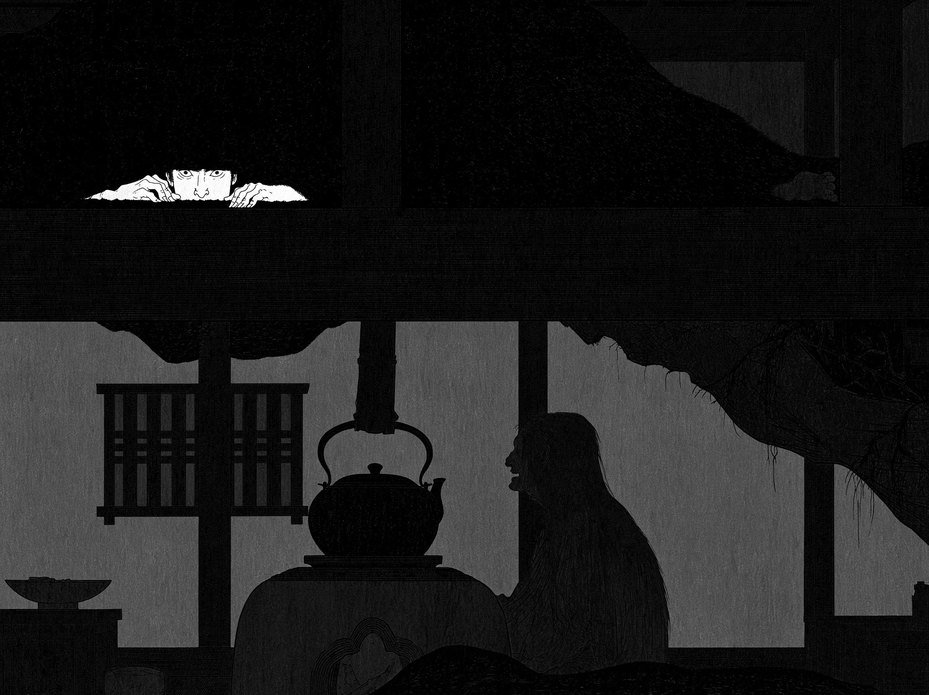
At a place in the northern part of Yamashina she found what she needed: on a slope, something built like a country villa, old, broken and falling down, with no sign of anyone living there.
Here I will give birth, she thought, and come away alone. She climbed the fence and went in, and sat down on the boarding, rotten in places, and rested.
The Old Woman
Then she heard someone coming from inside the house.
A sliding door opened and an old woman came out, white-haired.
She braced for it — for the scolding, for being driven off. Instead the old woman smiled, and asked what sort of person she was, arriving so unexpectedly.
So the young woman told her, weeping, exactly what had happened. And the old woman said: how very pitiful. Give birth here.
She took her inside, put down what poor matting she had, and the girl was delivered — easily, and quickly — of a fine boy.
The old woman was delighted. I am old, she said, and living out here in this backwater, so I do not keep the pollution rules. Stay about seven days and then go home. She had water heated, and the baby washed.
Three days of this. The young woman thought: the Buddha has helped me.
Six Syllables
Two or three days in, she was dozing in the daytime with the baby laid beside her.
The old woman looked at the child and said, to herself, “How delicious. Just one bite.”
The tale gives it as something the young woman faintly heard, half asleep. Then she came fully awake, and looked at the old woman, and was seized with terror.
This is an oni, she thought. I am going to be eaten.
The Escape
Nothing melodramatic happens. She waits.
She goes on as before until a day when the old woman’s midday nap ran long. Then, quietly, she had the serving-girl take the baby on her back, made herself as light as she could, prayed — Buddha, help me — and went out.
And then she ran, and ran, and kept running along the road, and was out at Awataguchi before long.
From there down to the riverbed, into a small house belonging to strangers, where she changed her clothes. She waited for dusk, and at nightfall she walked back to her master’s house.
She gave the child to someone to raise.
She never learned what became of the old woman, and for the rest of her working life she never told anybody this had happened. She told it only when she was old.
The Seven Days
One line in the middle deserves its own paragraph, because it is the only piece of social explanation the tale offers.
I am old, the old woman says, and I live out here in this backwater, so I do not keep the pollution rules — stay seven days.
Childbirth was ritually polluting, and a household that observed the rules could not take in a stranger giving birth on its floor. That sentence is the hinge on which the young woman’s survival appears to turn, and it is offered as the ordinary reason a remote old person could do what nobody in the capital would have done for her.
It is also, read a second time, the thing that explains why she is safe to eat. Nobody who keeps the rules comes here. Nobody will come looking. The tale never says that, and the old woman does not need to.
What the Compiler Made of It
His moral is about property. In old ruined places of that sort, he says, there is always something living. That old woman saying just one bite was certainly an oni or the like. Therefore one should not go into such places alone.
That is a sound warning and it is not what the tale is about.
Read it again and the horror is placed very precisely. The old woman is the only person in the whole story who is kind to her. The mistress is not told. The kin do not exist. The father of the child is not mentioned once. The single act of shelter offered to this woman in her life comes from the thing that was working out how to eat her son.
And the last detail is the one that stays. She got back, resumed her duties, looked as if nothing had happened — exactly as she had planned it — and said nothing about it until she was old. The plan worked. That is the part nobody warns you about.
Sources
- Konjaku monogatarishū 今昔物語集, twelfth century; book twenty-seven, tale fifteen, “How a woman going to give birth went to Minami-Yamashina, met an oni and escaped” — the title says south Yamashina and the tale itself says north, which is the text’s own discrepancy and not a slip here. Read here in the text of the tale itself: her want of kin, the pregnancy, her plan to bear the child in the mountains and die unnoticed, the departure at dawn, the ruined villa in northern Yamashina, the old woman’s welcome and her remark about not keeping the pollution rules, the birth of a boy, the words spoken over the child, the escape during the nap, Awataguchi and the change of clothes, the giving away of the child, her long silence, and the compiler’s closing warning.
The readings in “What the Compiler Made of It” are KWAIDANOTE’s own.
Found an error? Write to kwaidanote@gmail.com — corrections are made on this page and dated.