Five Ways to Survive a Funayūrei
The Other Layer
The earlier note on this site about the funayūrei was built from a vocabulary of fishing villages: a dozen local names along the coast, and one shared instruction — knock the bottom out of the ladle before you lend it.
That is the folklorist’s layer, collected in the twentieth century from people who still used the words.
Underneath it is a different one. A lecture course of the 1890s gathers what the Edo books said about the same thing, and the Edo books are not interested in vocabulary. They are interested in what happened on a particular night, and in what worked.
Between them they supply five separate ways of getting home, and only one is the one everybody knows.
How It Arrives
First, the sequence, because no modern account gives it.
The thing begins, one book says, as a wisp about the size of a handful of cotton, drifting on the waves as though blown there. As the white thing slowly grows, a face forms on it — eyes and a nose come — and there is a faint voice, like someone calling to a friend.
Then dozens appear at once, surfacing near and far. They come up with the manner of things about to board. They get their hands on the gunwale and hold the boat back, and the crew, rowing, cannot get away.
And then they speak, and the book is careful about this: the words they say are perfectly distinct.
One: The Ladle
What they say is inada kase — lend us an inada.
The book stops to explain the word, which is the detail that gives the whole thing away. Inada is not a literary term. It is sailors’ slang for the big dipper carried aboard. The creatures are asking for a working tool by the name the crew use for it among themselves.
A man who knows his business takes the dipper, knocks the bottom out, and throws it to them. They take it and bail with all their strength, trying to fill the boat. Give them one with a bottom in it and they will scoop the sea aboard and sink you.
That is the same rule, with the same stated reason, that the fishing villages were still giving three centuries later — two entirely separate bodies of evidence agreeing on both the action and the mechanism.
Two: Food
The same passage crosses to China for a comparison, to a stretch of water known as the Weeping Demons’ Shoal.
There, when a boat comes on, over a hundred of them swarm up: short, stunted figures, headless, one hand and one foot apiece, fighting to overturn the vessel.
And the remedy there is not a tool. Throw them the crew’s food and they vanish.
Set the two side by side and the difference is the whole argument. One coast disables the thing’s equipment; the other feeds it. The first treats it as an adversary with a method; the second treats it as a hungry crowd.
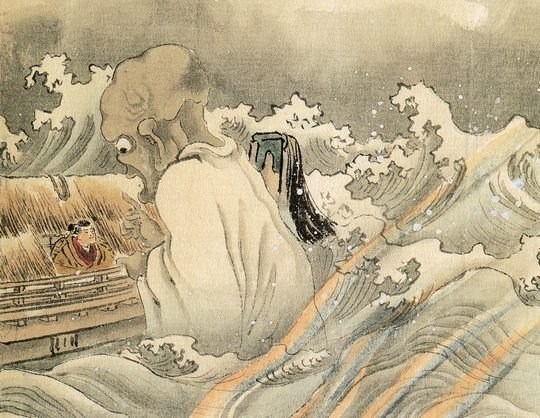
Kawanabe Kyōsai’s ship ghosts. Public domain, via Wikimedia Commons.
Three and Four: Silence, Then Fire
The best case in the section comes from a book of strange travels, and it reads like a deck log.
A vessel of about five hundred koku was going from Chikugo to Nagasaki. There was no wind, so she lay at anchor offshore waiting for one, from the Hour of the Sheep until the Hour of the Dog. It was the tenth of the seventh month; the moon had gone west and the light was very poor; it clouded over, and a sudden squall came down, and the offing went darker still.
Out of that came a ship rowing hard, driving straight at them. Voices, distant at first, then close.
What the crew did is the first countermeasure. From the master down to the last hand, they shut their mouths.
The voices came right up, and went round and round the ship, and grew wilder — and the master forbade anyone to answer.
Then, after a while, one of the hands did the second thing. He set fire to a piece of matting and threw it into the sea, aiming at the voices. The voices stopped at once.
A following wind got up, they made sail, and were into Nagasaki near dawn. Asking about it afterwards, they were told it had been a funayūrei.
The writer’s own comment is worth having. The souls of those lost at sea gather, he supposes, using warmth against the cold — perhaps because this life is still dear to them. And that driving them off with fire should work, he says, is in any case a strange thing.
Five: Not Being Impressed
The last one is not a technique at all.
A book of window-side talk gives an account of a celebrated master mariner, a man who had run every dangerous water in the country. His standing rule was that one should think hard before sailing on the last day of the month.
One time he was at sea alone when the wind turned, the seas came against him, black cloud came over, and the ship was flung up as though into the air. Anybody’s spirit would have failed. He simply crouched down and did not move.
And facing him there came up a great monk, a jō tall, with eyes like mirrors daubed with vermilion, who said to him: is my form not terrifying?
He answered: apart from making a living in this world, there is nothing especially terrifying.
The apparition vanished on the spot, the wind and sea went down, and he got home with his life.
I would put that line up against anything in this subject. It is not a charm and not a prayer. It is a professional seaman being asked whether he is frightened, and answering that the frightening thing is the job.
The Lights That Argue
One more item, because it is the only case here where the supernatural and the navigational aid are in direct competition.
On stormy nights, people ashore would climb the high ground on the seaward bearing of the sea lane and light beacon fires to guide the boats in. And the demons would raise fires out at sea as well, to confuse them.
So crews would fall to arguing — is the southern light the one the people lit, or is the northern one demon-fire? — and lose the lane, and drift about while they disputed it, and be drawn off and drowned, and become demons in their turn.
One sailor’s rule for telling them apart: a human fire stays where it is; a demon fire will not keep still, rising to the right and hiding to the left. Demons also put up dozens of false sails and appear to run before the wind. A human sail runs with the wind; a demon sail goes against it.
And then the honest sentence: faced with the thing, even an old hand who has seen it before loses his head, and it is hard to come out of it alive.
What Was Actually Out There
The lecturer, having printed all of this, gives his own account, and it is a list of what a person at sea at night is in fact looking at: the light of waves and of sea creatures, large fish breaking the surface, faint mist hanging, and drifting wreckage and broken timber.
All of which, he says, brings on illusions of various kinds — the same as treading on a rope and taking fright at a snake, or seeing dry pampas grass move and calling it a ghost.
He is largely right, and it does not touch the interesting part. Every one of the five responses above was devised by someone who believed the thing was real. The bottomless ladle, the thrown food, the shut mouth, the burning mat and the flat answer are five different theories of what kind of being it was — a thief, a beggar, a caller, an enemy, and a bully — and each crew’s theory is visible in what they reached for in the dark.
Sources
- Yōkaigaku 妖怪学, by Inoue Enryō 井上円了; the section of the miscellaneous division on the funayūrei, which quotes the works below and closes with his own explanation from waves, sea life, fish, mist and floating wreckage, and from anticipatory illusion.
- Seji hyakudan 世事百談: the drowned coming back to sink passing boats; the Chinese shoal where over a hundred headless, one-handed, one-footed figures swarm and are dispelled by throwing them the crew’s food; the wisp of cotton that grows a face; the cry of inada kase and the note that inada is the sailors’ word for the large dipper; the bottomless dipper and what happens if it has a bottom; the beacon fires and the demon fires, and the sailor’s rules for telling human from demon fire and human from demon sail.
- Kokon hyakumonogatari hyōban 古今百物語評判: the question about lights and figures seen on rough seas in the west and north, and the answer that the fire seen on the open sea is a yin fire of the water, with the further remark that the spirit of a drowned person may indeed appear as fire and take shape.
- Sessei kiyūdan 摂西奇遊談: the vessel of about five hundred koku from Chikugo to Nagasaki, the tenth of the seventh month, the squall, the ship that came rowing, the crew’s silence, the burning matting thrown toward the voices, and the entry into Nagasaki near dawn.
- Usō kanwa 雨窓閑話: the master mariner, his rule about sailing on the last day of the month, the great monk a jō tall with eyes like vermilion-daubed mirrors, and his answer.
- All of the above are read here in the quotations given in the lecture course; none of these works was consulted in its own edition for this note, and their dates and authors were not established.
The reading in “What Was Actually Out There” is KWAIDANOTE’s own.
Found an error? Write to kwaidanote@gmail.com — corrections are made on this page and dated.