Urashima Opens the Box Three Times
The Story Everyone Knows
A fisherman rescues a turtle. The turtle takes him to a palace under the sea, where a princess entertains him. When he asks to go home she gives him a box and tells him not to open it. He returns to find that centuries have passed, opens the box, and becomes an old man.
It is the most widely told story in Japan, and three of its earliest appearances survive. They do not agree about any of the parts people remember.
720: There Is No Box
The oldest is in the Nihon shoki, under the seventh month of the twenty-second year of Yūryaku. It is four lines long.
A man of Tanba, Urashima-ko of Mizunoe, went out in a boat to fish and caught a great turtle, which turned into a woman. He was taken with her and made her his wife; they went together into the sea, reached Hōrai, and saw the company of immortals.
And then the chronicle says: the story is in another volume.
That is where it stops. There is no box, no return, no old age. The compilers of the national history knew a longer account, declined to copy it out, and referred the reader to a book that has not survived.
The earliest surviving mention of Urashima is a cross-reference to something we do not have.
Two things in those four lines are worth holding on to.
The first is where he goes. The chronicle does not send him to a palace under the sea. It sends him to Hōrai, the island of the immortals off the Chinese coast, a destination with several centuries of Chinese literature already attached to it and no dragons in it. The undersea palace arrives later and from elsewhere.
The second is the date. The entry is filed under the twenty-second year of Yūryaku, which places the event some two and a half centuries before the book that reports it. Even in 720 this was being written down as something that had happened long ago — which is the position every later teller has also occupied, and it has been receding ever since. The story was already old when the oldest surviving book wrote it down.
The Poem: He Dies
The second is in the ninth book of the Man’yōshū, a long poem by Takahashi no Mushimaro, and it is the version closest to the one children are taught.
The woman here is the daughter of the sea god, and she is not given a name. He is warned. He opens the jewelled casket. His spirit goes out of him at once; the young skin wrinkles; the black hair turns white.
And then the poem uses the word. He died. It is not an implication or a figure of speech; the text says that his life ended.
The Gazetteer: He Flies
The third is the longest, and it is a fragment — a passage from the gazetteer of Tango province, preserved in quotation.
Here the woman has a name: Kamehime, turtle-princess. Here there are exchanges of poetry, and a term of years, and a promise made properly.
He forgets the promise and opens the box. And what the text says is that his fragrant body went up on the wind and the cloud and flew away into the blue sky.
It does not say he died. And the passage does not end there: he laments, and poems are exchanged afterwards, which is difficult to arrange for a dead man.
So one text has no box, one has a death, and one has a body leaving on the wind with verses following it.
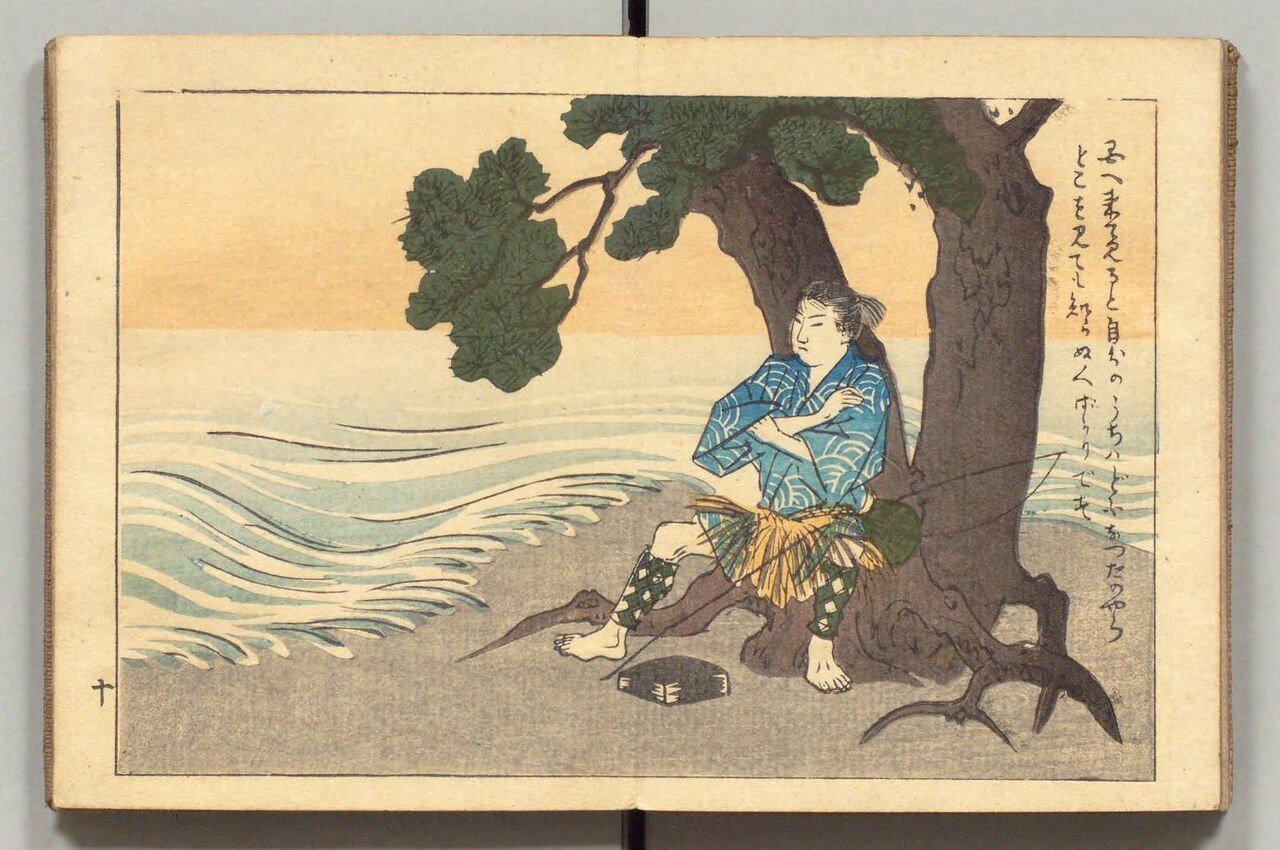
A storybook of 1899: the princess and the palace under the sea, neither of which is in the three oldest texts. Public domain, via Wikimedia Commons.
The Names Are Not in Any of Them
The princess everybody names — Otohime — appears in none of the three.
Neither, strictly, does the dragon palace. The chronicle sends him to Hōrai, the Chinese island of the immortals, which is a different address with a different literature behind it. The box has a different word in each telling.
Otohime, the dragon palace and the jewelled hand-box belong to the later retellings, and the set in its familiar form is generally traced to the storybooks of the Muromachi and Edo periods. That last point is reported here at second hand; those texts were not consulted for this note.
What the Differences Are Doing
It is tempting to treat the three as damaged copies of one original and to ask which is closest to it. The shapes of the endings suggest a better question.
A long poem on this subject is a poem about mortality, and it requires a death; without one there is nothing for the last lines to do. A provincial gazetteer is a document about a place, and it requires a departure that leaves something behind — a name, a set of poems, a claim the district can keep. A national chronicle is an administrative record, and it requires only that an event be registered and filed.
Each text ends the story in the way its genre needs it to end. They are not corruptions of one another. They are three competent writers solving three different problems with the same material.
The gazetteer’s ending repays a second look on this point. A body that rises on wind and cloud into the blue sky is not a punishment; in the vocabulary available to that writer it is close to how one describes an ascent to the immortals, which is where the chronicle had sent him in the first place. Read that way the box does not destroy him. It sends him back.
Whether the compiler meant that is not something this note can settle, and the passage does not say. What can be said is that the three endings are not on a scale from mild to severe. One of them may not be an ending at all.
What the Deferral Is Worth
Which brings the matter back to the four lines of 720 and their refusal.
The oldest text we have points at a fuller account, says it is elsewhere, and moves on to the next entry of the year. Everything written about Urashima since — the poem, the gazetteer, the storybooks, the school readers, the statue on the harbour wall — has been supplying that missing volume.
The famous ending, the one where a man opens a box and the years arrive all at once, is not the original. It is one early solution among several that were tried within a century or two of each other, and it happens to be the one that kills him.
Sources
- Nihon shoki 日本書紀, 720; seventh month of the twenty-second year of Yūryaku, ending with the note that the account is in another volume. Commons
- Man’yōshū 万葉集, book nine, the long poem by Takahashi no Mushimaro 高橋虫麻呂 on the man of Mizunoe.
- Tango no kuni fudoki 丹後国風土記, surviving fragment; the woman named Kamehime 亀比売, and the body carried off on wind and cloud.
- On the later provenance of the names Otohime and the dragon palace: secondary accounts; the Muromachi and Edo storybooks were not consulted for this note.
Further Reading
- Michael Dylan Foster, The Book of Yōkai: Mysterious Creatures of Japanese Folklore, 2015
The reading in “What the Differences Are Doing” is KWAIDANOTE’s own.
Found an error? Write to kwaidanote@gmail.com — corrections are made on this page and dated.