The Funayūrei Asks for a Ladle
A Word That Is Not Local
Funayūrei — ship ghost — is the word English uses, and it is also the word standard Japanese uses. It is not, on the evidence, the word the fishermen used.
The evidence is a classified vocabulary of Japanese fishing villages compiled by Yanagita Kunio: a dictionary of the words coastal communities actually used, sorted by subject. Its entries on this creature show something that a single-name encyclopaedia entry cannot. There is no single name. There is a scatter of local words, one or two per stretch of coast, and funayūrei appears in the book mostly as the thing other places say.
One entry states this outright. Describing a term used along the Iwaki coast, it notes that in most other districts this is called funayūrei — which is the sound of a compiler reaching for the general word because the local one will not travel.
The Names
A partial list, from the entries, with the districts as the book gives them:
Ayakashi in northern Kyūshū, where the book says the word is still alive. Mōjabune, the boat of the dead, in the Kunohe district of Rikuchū in the far north-east. Mayoibune, the lost boat. Mayoi on Himeshima in Chikuzen; mayoibotoke on Ainoshima in the same province; toboshi on Enoshima in Hizen; and at Hirado simply hi. Inadakase on the Iwaki coast. Noro-uma in the Ōchi district of Iwami, listed there with the sea-monk. Yoiyoibune at Fukuma in Munakata. Mōreibi at Onagawa in Rikuzen. Hikimōren in the Watarai district of Ise. Sokoyūrei and shikibotoke in the Gotō islands and Hirashima. Ugume on Iki and Ojika.
That is over a dozen words for one thing along a single country’s coastline, and several of them do not obviously mean the same thing. Some are ghosts, some are lights, some are boats, one is a word for a Buddhist departed and one is a word for a horse.
Read the list again and the disagreement is specific. Several of the words name the dead and say so: mōja is the departed, botoke is the word for one who has died, mōrei is a departed spirit, yūrei is a ghost outright. Others name no person at all. Hi is fire. Toboshi is a lamp. Mōreibi splits the difference by putting a light on the end of a spirit.
So one stretch of coast held that it was people and the next held that it was a light on the water, and both were describing the encounter closely enough that a compiler could set the entries side by side.
What They Ask For
What the names do not share, the encounter does.
A vessel comes alongside, or a voice does, and it asks to borrow something. In the Iwaki entry the thing requested is an inada, the dipper used aboard for water. In the north-eastern entry it is an akatori, the bailer. Elsewhere it is a hishaku or a shakushi, the ordinary ladle of the kitchen.
In every case the object is an implement for moving water from one place to another. That is the constant. The name changes at every headland; the request does not.
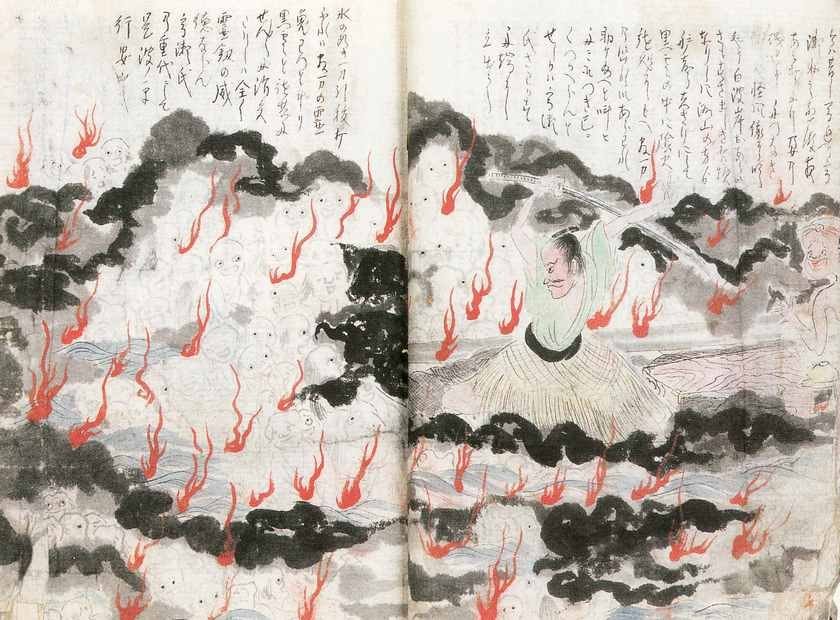
A ship ghost in a late Edo picture-book of monsters. Public domain, via Wikimedia Commons.
Knock the Bottom Out
And the answer is the same everywhere too, and it is the reason this material is worth an article.
You lend it. You do not refuse, and you do not pray, and you do not run. You take the ladle, and you knock the bottom out of it, and then you hand it over.
The Iwaki entry is the one that says why, and it says it in the flat tone of a man explaining a rule to an apprentice: the boat that meets this thing must knock the bottom out of the dipper before lending it, because otherwise, in no time at all, the boat will be full of seawater.
That is not an exorcism. It is a countermeasure with a stated physical mechanism — the thing is going to use the borrowed implement to bail the sea into you, so you give it one that cannot hold water. The logic would work on a human thief. Nothing in it appeals to a god, a sutra, or a priest.
I find this the most impressive piece of folk reasoning on the site so far, and it is entirely characteristic of how sea people think. The supernatural threat is accepted without argument; the response is engineering.
The Other Two Remedies
Two further countermeasures appear, and they are worth setting beside the ladle because they are of a different kind.
In the north-east, if you meet the boat of the dead, you scatter oni no mame — demon beans — and it vanishes. These are the beans of the spring bean-throwing rite, kept back for the purpose; a separate seasonal vocabulary in the same body of work records that some people save the beans from that rite specifically so as to have them aboard when the boat appears at the midsummer festival.
And in northern Kyūshū, the ayakashi is said to disappear if you make an offering of salt and water to it.
So within this one compilation the coast holds three answers side by side: a ritual one, an offering, and a mechanical trick. (The wider collections carry more — ash, stones, tobacco smoke, rice cakes — which is worth knowing before treating these three as the whole set.) The mechanical one is the one that spread furthest — it turns up under at least five different names in these entries, from Iwaki to Iwami to Kyūshū, while the beans stay in one district and the salt in another.
When It Comes
The timing is consistent in a way the names are not. The boat of the dead appears at the midsummer festival of the dead, and in that district the fishing boats come home before dark for the duration. The lost boat is likewise said to appear mostly in that month.
But the entries do not make it a rule. The north-eastern one adds, in passing, that it can come at other times too. That small clause is the difference between a belief and a regulation, and the compiler kept it.
The descriptions, where they exist, are restrained to the point of being unsettling. On a bright moonlit night you may see a sailing vessel going against the wind. Or you may see nothing at all, and hear people talking.
Where This Sits in the Book
One more thing about the source, because it changes how the material should be read.
None of these entries is filed under monsters. They sit in a chapter on belief and practice — the same chapter as the rites, the taboos, the words for what you must and must not do at sea. The compiler was not making a bestiary. He was recording a working vocabulary, and the ghost boat is in it the way the weather is in it.
That is why the ladle survives in so many places and the name in none. A name is a thing you tell visitors. A rule about what to do when something comes alongside at night is a thing you tell the boy on his first season, and it gets passed down intact because the consequence of not knowing it is stated.
Sources
- Bunrui gyoson goi 分類漁村語彙, compiled by Yanagita Kunio 柳田国男; the entries for ayakashi, mōjabune, mayoibune, mayoibotoke, inadakase, noro-uma, shikiyūrei and related terms, in the chapter on matters of belief. The local names, districts, the requested implements, the instruction to knock out the bottom and its stated reason, the demon beans and the offering of salt and water are all taken from these entries.
- The north-eastern material on the boat of the dead is credited in the entry to a district gazetteer; the gazetteer itself was not consulted for this note.
- A seasonal vocabulary compiled by the same hand carries the note on saving beans from the spring rite for use against the boat of the dead, citing the same gazetteer.
The readings in “Knock the Bottom Out” and “Where This Sits in the Book” are KWAIDANOTE’s own.
Found an error? Write to kwaidanote@gmail.com — corrections are made on this page and dated.