Who Made Shuten-dōji
The Demon Has a Childhood
Partway through the Edo printed version of the tale, with the wine going round and the disguised soldiers sitting at his table, Shuten-dōji tells his guests where he came from. He does it unprompted, in the manner of a host who has had enough to drink.
He was a boy at a temple in Echigo, in the north. He killed monks there. He went up Mount Hiei, and was driven off it by Saichō when Enryaku-ji was founded on the mountain. He moved to the next peak, and was driven off that one by Kūkai. Only after Kūkai’s death did he come back to the high ground where the soldiers have now found him.
Every move in that account is made by somebody else. The demon does not choose a lair; he is relocated, twice, by the two most revered teachers in Japanese Buddhism, and he settles where he does because the last man who could expel him has died.
The older telling already carries the seed of this. In the picture-scroll version, the earliest surviving form of the story, he has lost a mountain called Hirano to Saichō’s foundation.[1] The Edo text adds the childhood in Echigo and the second expulsion.[2] The biography grew, and it grew in one direction: further back, and more of it done to him.
Two Books, Three Centuries Apart
The story survives in two main shapes.
The first is a painted scroll, the Ōeyama ekotoba, known as the Katori manuscript after the shrine family that owned it. It is usually dated to the second half of the fourteenth century and is now held as an Important Cultural Property in a museum in Osaka. It is the oldest surviving telling.[1]
The second is the printed one: “Shuten-dōji” as it appears in the Otogi-zōshi, the Edo-period woodblock series issued by an Osaka bookseller named Shibukawa.[2][3] That series is the reason the phrase otogi-zōshi exists at all — it began as the title of a particular publisher’s set of twenty-three booklets and was later borrowed by scholars as the name for the whole body of medieval short tales. Our Hitokui volume follows this printed text.
Which Mountain
Ōeyama is a real place, or rather two of them, and the tradition has never fully decided which.
One candidate is the pass called Oi-no-saka, on the old road leading west out of the capital — close enough that a demon living there would be a demon at the city’s shoulder. The other is the mountain of the same name much further off, in Tanba and Tango, a serious day’s travel away. The Noh texts point to the near pass; the printed tale sets the fortress on the distant mountain.
As the story aged, the demon moved further from the city. At the near pass there is still a mound that local tradition identifies as the burial place of his head, which is the kind of detail that survives a relocation because nobody moves a grave to suit a book.
The Man Who Killed Him
Minamoto no Yorimitsu was real. He was born in 948 and died in 1021, the eldest son of a provincial warlord, and his documented career is largely administrative: governorships in Bizen, Tajima and Mino, and a long profitable attachment to Fujiwara no Michinaga, the most powerful man at court. He was wealthy and he was useful.
What the record does not show much of is fighting. The most famous demon-killer in Japanese literature is a man whose surviving paperwork is about provinces and patronage. The legend attached itself to him later, and it attached firmly enough that his four retainers became a fixed set: Watanabe no Tsuna, Sakata no Kintoki, Usui Sadamitsu, Urabe no Suetake. Their names are stable; their historical footing is not equally solid, and one of them, Kintoki, has been absorbed into an entirely separate childhood legend of his own. Some versions of the tale add a sixth man, Fujiwara no Yasumasa, who is said to have received the commission first and handed it on.
Whether any expedition took place is another matter. Modern scholarship generally treats the demon-hunt as a story rather than an event, with the earliest version taking shape in the fourteenth century, some four hundred years after Yorimitsu’s death.
How the Soldiers Won
They did not win by fighting, at least not at first.
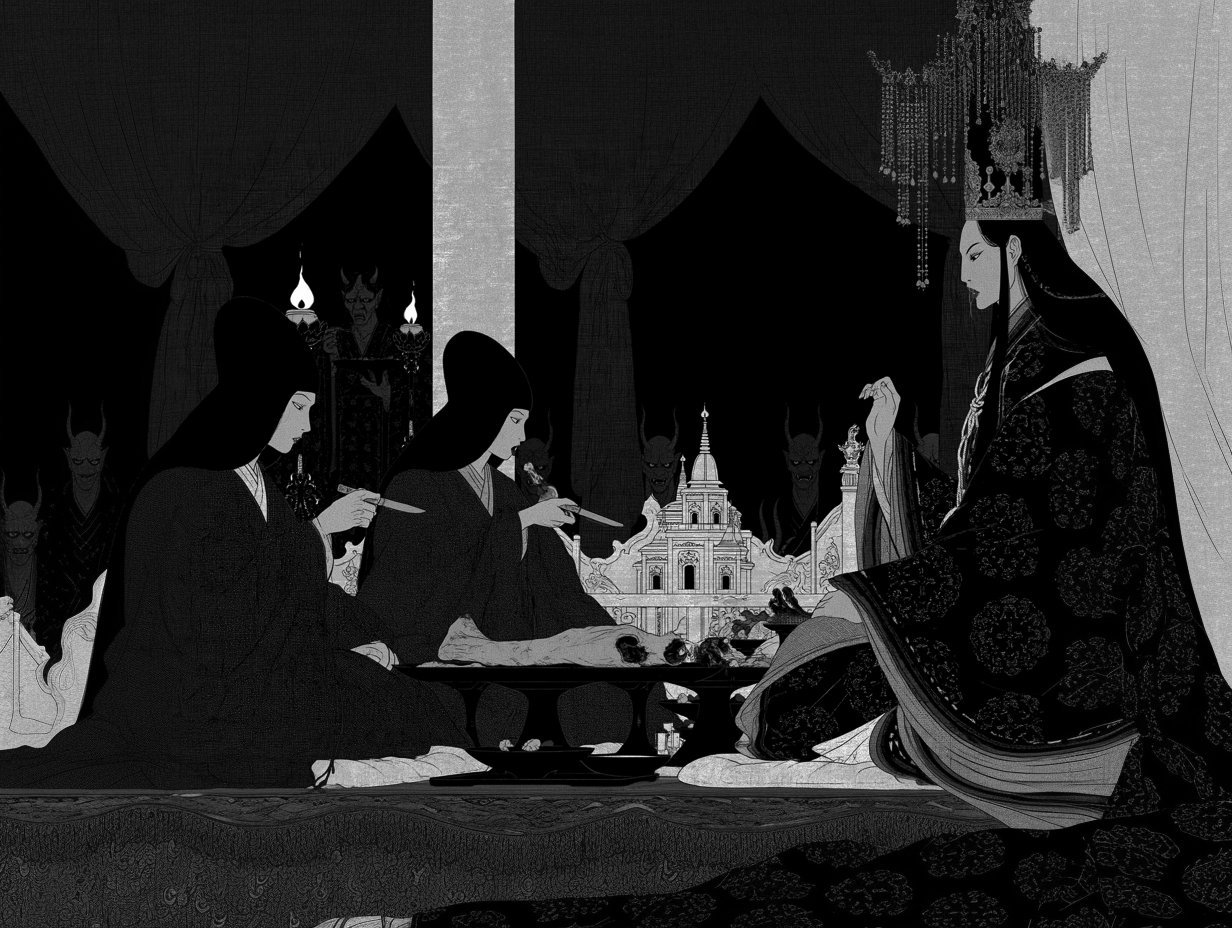
They travelled disguised as yamabushi, mountain ascetics, with their armour in the luggage. On the road they were given wine by three old men who were gods in human form; the wine’s name in the text says what it is for, being a help to gods and a poison to demons. They arrived as pilgrims asking for shelter, were received as guests, drank with their host, ate what he set in front of them, and cut off his head while he slept.
The dying speech that follows is the most quoted line in the whole tradition, and this site’s note on man-eaters already takes it up, so it can stay where it is. What is worth adding here is that the speech only works because of the biography. A demon with no history could simply be killed. This one has been told, by his own account, that the holy men of Japan expel him wherever he settles — and then a party of men dressed as holy men arrives at his gate and asks to come in.
Why This One Lasted
There are more frightening oni in the older collections, and several of them eat people more efficiently.
What this story has that the others do not is furniture. It has a named mountain you can walk up, and a second mountain that people will argue is the real one. It has a hero with dates and a paper trail. It has four companions whose names schoolchildren can still list, and a sword with a name, and a wine with a name. It is the tale that a place can be built around, and places were.
And it has the childhood. I find that the part that keeps it uncomfortable rather than merely exciting: before the demon is a problem to be solved by the state, he is a boy who was moved along, and the institutions that moved him are the same ones that eventually send the soldiers. The text does not comment on this. It simply puts the autobiography in the middle of the banquet, a few pages before the killing, and lets the reader carry both.
Sources
- Ōeyama ekotoba 大江山絵詞, illustrated scroll, second half of the 14th century; the manuscript formerly held by the Katori shrine family.
- “Shuten-dōji” 酒呑童子, in the Otogi-zōshi 御伽草子; Edo-period woodblock text. Wikimedia Commons
- Otogi-zōshi 御伽草子, the Shibukawa series of twenty-three booklets, Edo period, from which the genre takes its name. Wikipedia
Further Reading
- Noriko T. Reider, “Shuten Dōji: ‘Drunken Demon’,” Asian Folklore Studies, 2005
- Noriko T. Reider, Japanese Demon Lore: Oni from Ancient Times to the Present, 2010
- R. Keller Kimbrough and Haruo Shirane, eds., Monsters, Animals, and Other Worlds: A Collection of Short Medieval Japanese Tales, 2018
The reading in “Why This One Lasted” is KWAIDANOTE’s own.
Found an error? Write to kwaidanote@gmail.com — corrections are made on this page and dated.