Oni, Yamauba, and the Other Man-Eaters
Two Names in English
The Konjaku Monogatarishū, compiled in the early twelfth century, keeps its demons in book twenty-seven, and some of the titles there read like entries in a register: “How an Oni of the Agi Bridge in Ōmi Ate a Man.”[1] The word oni is usually given in English as “demon” or “ogre.” Its counterpart in the high country, the yamauba, becomes “mountain witch” or “mountain crone.” These are the two Japanese man-eaters an English reader is most likely to have met, and they are a fair place to begin.
They are not where the old records stop. Hitokui means simply “man-eater,” and in Japanese it is not the name of a creature. Followed through the court tale-collections, a state chronicle, temple papers, county gazetteers, and the books of the first folklorists, the word settles on a mother, a prince of the blood, a famous preacher, an emperor, and the people who live one ridge over. What follows is a short account of who, in those records, does the eating, and of how much the records are willing to say about it.
The Oni Keeps House
In the Konjaku, the oni is often less a visitor than a verdict. One tale in book twenty-seven closes with a sentence the compiler offers as settled knowledge: when a parent grows very old, that parent will surely become an oni and try to eat even their own children.[2] Nothing in the sentence is hedged. It is set down the way a later book might set down a fact about the weather.
The best-known oni of all, Shuten-dōji of Mount Ōe, appears in the Edo-period woodblock edition of the Otogi-zōshi not as a beast but as a host. His court receives guests, pours for them, and sets out dishes, and the horror of the tale is organized as hospitality.[3] His last words passed into the language as a saying, oni ni ōdō nashi, “there is no treachery in an oni,” spoken to guests who had lied their way to his table.
Some oni began as a line of verse. In the tenth century the poet Taira no Kanemori asked in a poem whether it was true that an oni was shut up in the Black Mound of Adachi. The official gazetteer of Adachi county, printed in 1911, records the full legend as local history, with a date in the year 726, a traveling monk, and a room the traveler was told not to look into, and it notes that it was Kanemori’s poem that made the place famous.[4] One reading, and the one the Hitokui retelling follows, is that the legend grew backward from the poet’s question into an answer.
The Old Woman in the Mountains
The yamauba is harder to pin to a page than the oni, because she lived mostly in kitchens rather than in books. The type folklorists call ushikata yamauba, “the pack-horse driver and the mountain woman,” is told the length of Japan. A man leading a loaded horse home over a mountain road at dusk is met by her, and she asks for part of the load, then another part, then another.[5] Each request is granted because it is so much smaller than dying. The tale has little interest in fangs. What it understands exactly is how a person can be consumed piece by piece while making a reasonable decision at every step.
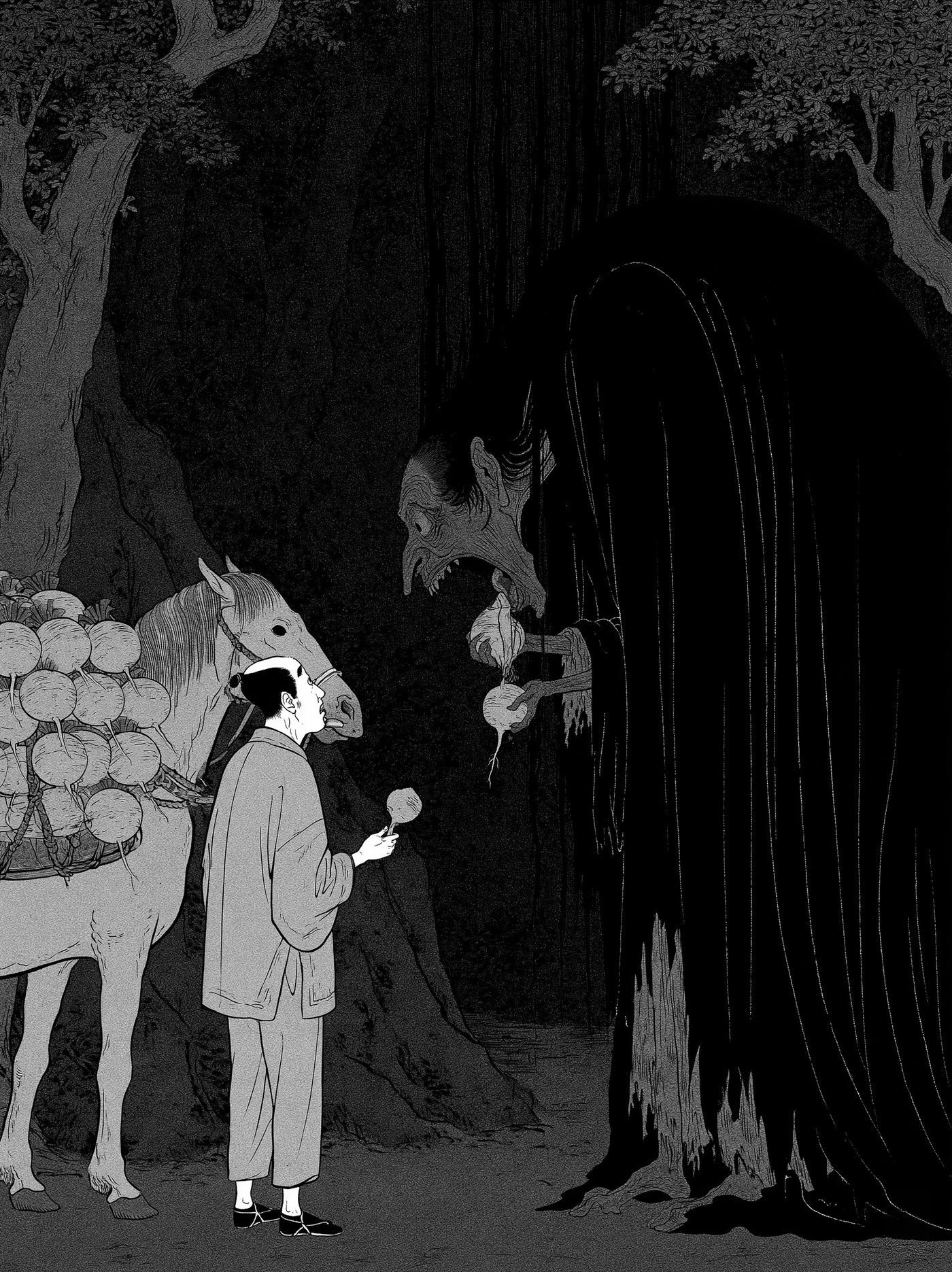
When Takagi Toshio assembled his Nihon Densetsu Shū in 1913 from material sent in by correspondents, he had to put the yamauba somewhere. The Echigo tale of Yasaburō’s mother went under “dog-god and werewolf legends.”[6] The filing is half the commentary. Immediately after it he printed a second telling, from the Yahiko side, which ends not with a killing but with an enshrinement: because the village children kept disappearing, the people built a hall and worshipped the old woman there, and the correspondent adds that she is the Myōtara-ten behind Yahiko shrine.[6] A man-eater could end her career as a god.
Here the two English names meet. The Konjaku compiler’s claim about the very old parent and the yamauba’s usual shape, an old woman at the edge of a hungry household, point to the same place. What strikes me in setting these records side by side is that the fear they return to is less a monster from the mountains than what someone at home might become.
A Prince, a Preacher, an Emperor
Some of the eaters in the record have names and dates.
The Shoku Nihongi, the court chronicle of eighth-century Japan, records under the year 761 that Prince Ashihara, a great-grandson of Emperor Tenmu, fell into a rage while gambling and drinking, stabbed his companion to death, cut flesh from the dead man’s thigh, and made it into namasu, a dish of raw fish or meat dressed in vinegar. The chronicle’s judgment on him is four characters long: tensei kyōaku, “evil by nature.”[7] The account of the killing ends at the making of the dish. It contains no word for eating. The Hitokui retelling supplies the meal and says so in its note; the chronicle does not.
A preacher called Ryūzō-bō is a harder case. The chronicle of the Tendai school records that in the fourth month of 1275 the monks of Mount Hiei burned the dwelling of a “Ryūzō Shōnin,” and it gives no reason.[8] The reason, that he had been found in the capital making human flesh his food, survives in a Nichiren-school letter written two years later, and in the school’s later biographies, when the same preacher was drawing crowds at Kamakura and a disciple of Nichiren had just faced him in debate.[9] The sources are partisan. The school that kept the accusation is the school that claimed the debate, and the identification of the Tendai chronicle’s Ryūzō with Nichiren’s was made by modern scholars. Whether a corpse-eater preached in two capitals, or a preacher was eaten by a rumor, the record cannot now decide.
The charge reaches the throne at least once. A fourteenth-century collection of shrine legends, the Shintō-shū, lays it on Suizei, the second sovereign in the traditional line, one of the early emperors about whom the chronicles record almost nothing.[10] Into that documentary emptiness the medieval legend poured a man-eater.
Hungry dead belong on this list as well. Lafcadio Hearn, who set down “Jikininki” in Kwaidan in 1904 without naming a source, glossed the word as “literally, a man-eating goblin,” and added that it seems to mean one class of gaki, the hungry spirits of Buddhist cosmology.[11]
The People One Ridge Over
The records come closest to the present in Tōno, in the mountains of Iwate. In 1910 Yanagita Kunio published what the Tōno storyteller Sasaki Kizen had told him, with the names of villages attached, and prefaced it with a wish that has been quoted ever since: that these tales might make the people of the plains shudder.[12] Tales six and seven are told as testimony. In each, a woman who vanished into the mountains is met years later by a man from her own district and speaks of the children she has borne there. In tale six she says her husband has eaten them all. In tale seven she says only that he takes them away because they do not resemble him, whether to eat them or to kill them she cannot say.[12] The record keeps her uncertainty exactly. It also has her report that four or five people like her husband gather once or twice between market days, and that, to judge by the food brought in from outside, they must go into town.
What the Record Will Say
A county gazetteer from Tokushima, printed in 1927, records an ox-demon, the ushi-oni, that caught and ate people and livestock, and names a local family tied to the story. In the next breath it doubts the account: a nearly identical tale is told in Iyo, and this one probably came in from that side of Shikoku; the bone said to be the demon’s, if it existed at all, was probably a whale’s. It adds that in the Uwa district of Iyo the ushi-oni had become a festival figure, a frame of bamboo and cloth with a papier-mâché head part oni, part ox, part dragon, carried by ten or so men walking inside it, and that people there felt the festival had not properly happened unless it came.[13]
Predator, relic, doubt, parade: the gazetteer gives a man-eater’s whole career in a page of local-government prose. The records do not agree about what the eater is. Most of them, whatever they believed, wrote it down in the same even hand they used for land boundaries, reign dates, and verdicts. Yanagita wanted the people of the plains to shudder. The documents themselves are, for the most part, calm.
Sources
- Konjaku Monogatarishū 今昔物語集, compiled early 12th c., book 27, tale 13, “Ōmi no kuni Agi no hashi no oni hito wo kurau koto” 近江国安義橋鬼噉人語. Wikimedia Commons
- Konjaku Monogatarishū, book 27, tale 22, closing sentence. Wikimedia Commons
- “Shuten-dōji” 酒呑童子, in Otogi-zōshi 御伽草子. Wikimedia Commons
- Adachi-gunshi 安達郡誌, gazetteer of Adachi county, Fukushima (1911), Ōdaira village, “Adachigahara oyobi Kurozuka” 安達ケ原及黒塚.
- Kusuyama Masao 楠山正雄, “Yamauba to mago” 山姥と馬子, in Nihon Dōwa Hōgyokushū 日本童話宝玉集 (1921–22), vol. 2.
- Takagi Toshio 高木敏雄, Nihon Densetsu Shū 日本伝説集 (1913), “Inugami densetsu oyobi jinrō densetsu” 犬神伝説及人狼伝説: “Yasaburō-baba” 弥三郎婆 and the appended Yahiko telling.
- Shoku Nihongi 続日本紀, completed 797, book 23, Tenpyō-hōji 5 (761). Wikimedia Commons
- Tendai zasu ki 天台座主記, entry for Kenji 1 (1275), fourth month.
- Nichiren 日蓮, Yorimoto chinjō 頼基陳状 (1277); and Nitchō 日澄, Nichiren Shōnin chūgasan 日蓮聖人註画讃, book 5, “Ryūzō-bō.”
- Shintō-shū 神道集, compiled c. 1352–61, book 2, article 6, “Kumano Gongen no koto” 熊野権現事. Wikipedia
- Lafcadio Hearn, “Jikininki,” in Kwaidan: Stories and Studies of Strange Things (1904), with the author’s note to the title word. Wikimedia Commons
- Yanagita Kunio 柳田国男, Tōno Monogatari 遠野物語 (1910), preface and tales 6–7. Wikimedia Commons
- Kaifu-gunshi 海部郡誌, gazetteer of Kaifu county, Tokushima (1927), “Legends”: “Ushioni setsuwa no kōgai” 牛鬼説話の梗概 and “Densetsu no kōsatsu” 伝説の考察.
Further Reading
- Lafcadio Hearn, Kwaidan: Stories and Studies of Strange Things (1904). Wikimedia Commons
Found an error? Write to kwaidanote@gmail.com — corrections are made on this page and dated.