The Arm Was Not Cut at the Rashōmon
The Scene Everyone Knows
A warrior rides out alone at night. At the Rashōmon, the great ruined south gate of the capital, something takes hold of him from behind. He cuts, and is left holding a severed arm. A diviner tells him to keep it sealed for seven days. On the seventh night his aunt comes to visit, asks to see the famous arm, seizes it, changes shape, and goes out through the roof.
It is one of the tidiest demon stories in Japanese literature. It is also, in that form, an assembly. The two halves come from different works, and the gate in the first half is not in the oldest text at all.
What the Oldest Text Says
The story’s earliest surviving telling is the Tsurugi no maki, the “scroll of the sword,” a chapter attached to the popular recensions of the Tale of the Heike. It is not part of the work’s original design — one edition’s own preface says plainly that the scroll is absent from the base text and was added because so many circulating copies carried it.[1] Its author is unknown and its date is not settled; late Kamakura to the fourteenth century is the usual estimate.
In it, Watanabe no Tsuna is sent on an errand and meets a young woman who asks to be escorted home. The text places the meeting exactly: he is crossing the Modoribashi at Ichijō and Horikawa — a bridge inside the city, on a street of the residential capital, not a ruin on its southern edge.
The woman asks to be carried. She becomes a demon, seizes his hair, and makes for Mount Atago. He cuts upward and falls with the arm.
The fourteenth-century Taiheiki tells a version of the same episode and moves it somewhere else again, to a wood in the province of Yamato.[2] Neither of the two earliest accounts puts the arm at the Rashōmon.
The Seven Days Belong to a Diviner
What follows in the Tsurugi no maki is more procedural than most retellings suggest. Tsuna takes the arm to Abe no Seimei, who reads it and gives instructions: seven days of strict seclusion, the arm to be sealed away and carefully guarded, and the Benevolent Kings Sutra to be recited throughout.
The seven days are not a demand from the demon. They are a ritual prescription, issued by a named specialist, with a scripture attached. The story is, in its oldest form, a case handled correctly and then lost on a technicality.
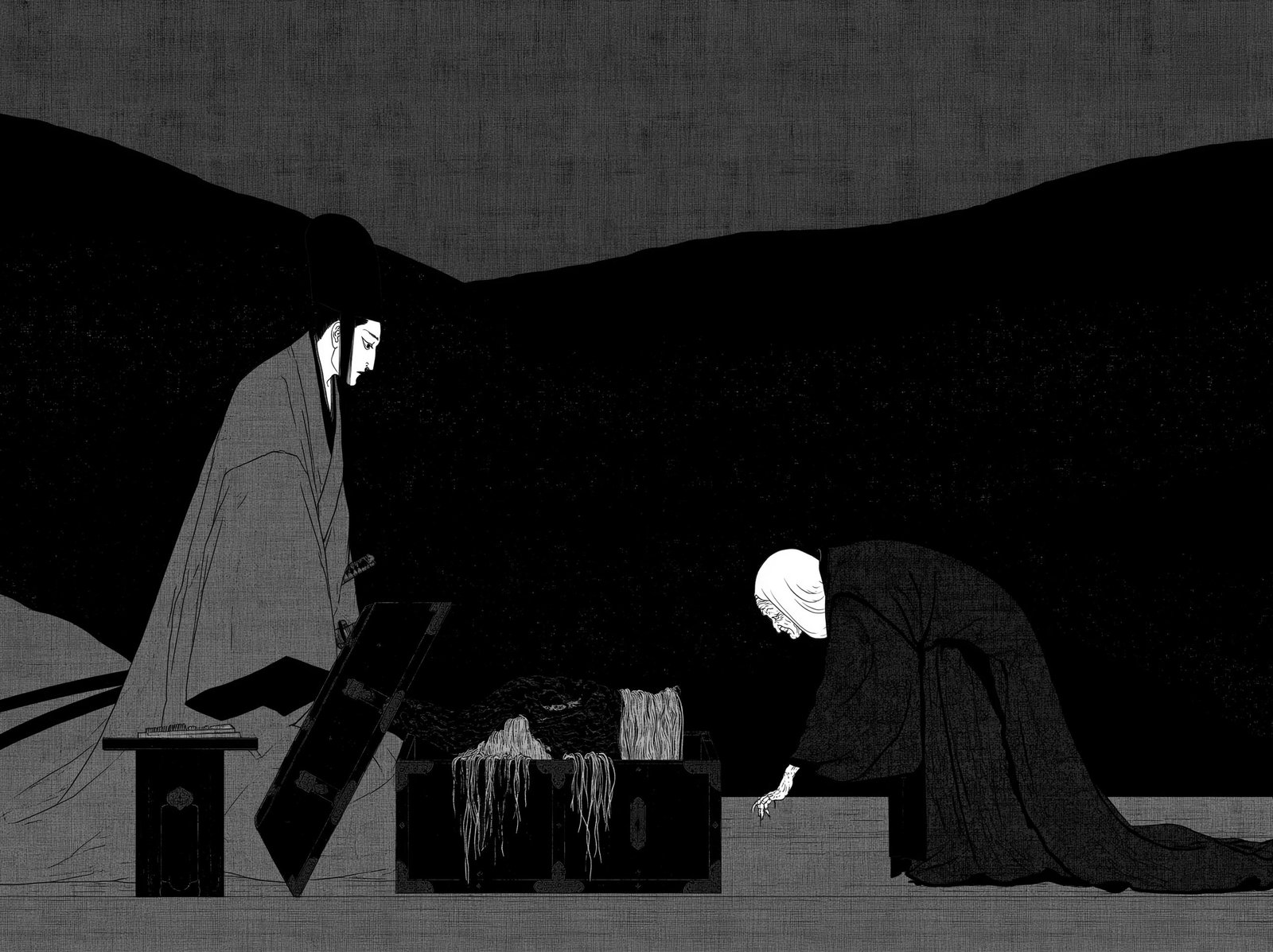
On the sixth evening Tsuna’s foster mother arrives from Watanabe, and the text stops to explain the relationship: she is his aunt. He is inside a seclusion he cannot break and cannot bring himself to turn her away. She asks about the arm, he shows it, and she says, in effect, that it is hers and she will take it — and goes out through the gable of the roof.
The chapter then ends with something odd and rather beautiful. Because of that night, it says, the houses of the Watanabe never put in a gabled roof. A demon story finishes as a rule of carpentry.
Where the Gate Came From
The Rashōmon enters through the theatre. The Noh play Rashōmon, by Kanze Kojirō Nobumitsu of the late Muromachi period, opens at a victory banquet after the Ōeyama campaign, where a rumour of a demon at the Rashōmon is repeated and Tsuna rides off to test it. He cuts the arm at the gate, and the demon vanishes upward promising to come back for it at a better time.[3]
That play ends where it ends. There is no seven days in it, no aunt, no recovery.
So the version now told everywhere is a splice: the gate and the cutting from one work, the seclusion and the visitor from another. The two are stitched together in Edo-period prose and on the kabuki stage, and by the twentieth century the join is invisible.
The Demon Has No Name
Our earlier note on Shuten-dōji traced how that demon acquired a biography; this one is about his lieutenant, and the lieutenant’s problem is the opposite.
In the Tsurugi no maki the creature is called oni and nothing else. In the Taiheiki passage it is called oni and nothing else. In the Noh play it is called oni and nothing else. Three of the earliest texts, and not one of them gives this demon a name.
Reference works in English often state that the name Ibaraki-dōji appears in the medieval chronicles. The texts do not support it. The earliest identification I have been able to confirm for the arm-cutting demon is a late-seventeenth-century chronicle of the Ōeyama wars, printed in 1681, which calls the demon at the gate Ibaraki-dōji.[4] The name itself is older than that as Shuten-dōji’s companion in the Ōeyama tales — but that is a different story, and the joining of the two is the point.
The demon’s birth legend is later still. The accounts that make him a child of Settsu, born already possessing teeth and abandoned in the village of Ibaraki, come from local topographies of the Edo period, the earliest of them published in 1701.[5] They are seventeenth- and eighteenth-century local writing, not medieval narrative.
One more caution, because the error is common: the dance play Ibaraki, in which the aunt appears and the arm is recovered, is not a Noh play. It is a nagauta dance drama by Kawatake Mokuami, first staged in 1883.
What Is Actually Old
Strip the late material away and the surviving core is small and much stranger than the assembled version.
A man crosses a bridge in his own city at night. A woman asks for help and he gives it. What attacks him wears a borrowed shape, and the shape it borrows to get the arm back is a relative who raised him. The horror is domestic throughout: a bridge people used, a house he had to let her into, an obligation he could not refuse, and afterwards a family that changed the way it built its roofs.
The ruined gate is grander. It is also the part that came last.
Sources
- Tsurugi no maki 剣巻, chapter appended to popular recensions of the Heike monogatari 平家物語; author unknown, late Kamakura to 14th century. Commons
- Taiheiki 太平記, war chronicle, 14th century; book thirty-two. Wikipedia
- Rashōmon 羅生門, Noh play by Kanze Kojirō Nobumitsu 観世小次郎信光, late Muromachi period. Wikipedia
- Zen taiheiki 前太平記, chronicle of the Ōeyama and Masakado wars, printed 1681.
- Setsuyō gundan 摂陽群談, topography of Settsu province, 1701. Wikipedia
Further Reading
- Noriko T. Reider, Japanese Demon Lore: Oni from Ancient Times to the Present, 2010
- Haruo Shirane, editor, Traditional Japanese Literature: An Anthology, Beginnings to 1600, Columbia University Press, 2007
The reading in “What Is Actually Old” is KWAIDANOTE’s own.
Found an error? Write to kwaidanote@gmail.com — corrections are made on this page and dated.