Do Not Even Talk About the One-Wheeled Cart
Item 394
A compendium of oral tradition published in Tokyo in 1913 runs to two large volumes. The Japanese portion of the first is divided into chapters, and the ninth chapter is for strange occurrences. Inside that chapter the entries are numbered straight through.
Number 394 is the katawaguruma, the one-wheeled cart.
This note is about the entry rather than the creature, because the entry is the thing that survives. What the cart does takes four sentences. How it is filed takes the rest of the article.
What the Entry Says
In the Kanbun era — the 1660s or early 1670s — in a village in the Kōka district of Ōmi, every night after it had grown late a thing called the one-wheeled cart would pass by, rumbling as it went.
Where it came from and where it was going, nobody knew.
And if you went out late and happened to meet it, however bold a man you were, you lost your senses on the spot. So not a single person in that place went out after dark.
The Rule Nobody Quotes
Then comes the sentence that makes this entry worth an article, and it is the one the English retellings leave out.
Nor was that all: even to sit inside your own house and speak of the one-wheeled cart brought a fearful curse. So at night every house in the village shut its doors fast and kept quiet.
That is a different order of thing from a monster on a road. A creature you can meet at night can be avoided by staying in. This one reaches indoors, through conversation, and the defence against it is silence.
Which means the entry describes a village in which the subject of the entry could not be discussed — and then a compiler two and a half centuries later gave it a number.
The Woman at the Door
A wife of that village, out of curiosity, wanted to see it just once.
Late one night she heard the cart outside, and put her eye to the crack in the door.
There was a cart with nobody pulling it, and it had one wheel, and a beautiful woman was riding on it. It stopped directly in front of that house. And it cried out, in a terrible voice, that rather than looking at her, the woman had better first go and look at her own child.
She ran to the bedding. Her child, two years old that year, was gone — no shape, no shadow.
The Poem
She grieved. Then she thought better of it, and wrote out a single poem, and pasted it up at her door.
The fault is mine and mine alone — O little cart, do not hide away a child who does not know which way to go.
The next night the sound came again out of the dark and stopped before the gate. The cart read the poem aloud, at the top of its voice. And then it said, sadly: I give the child back. But having once been seen by a human being, I can no longer remain here.
It returned the child and went away, and never came again.
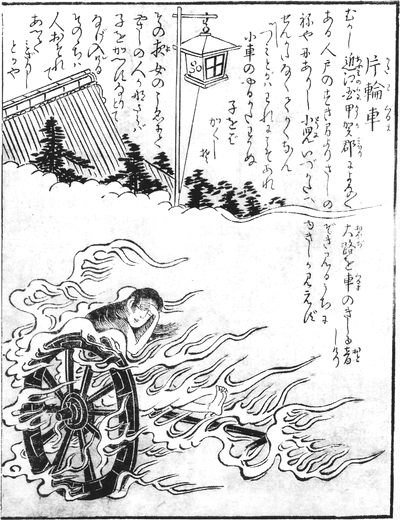
Toriyama Sekien drew the cart in 1781 — the familiar picture, and a different line of transmission from the entry this note reads. Public domain, via Wikimedia Commons.
What Kind of Book This Is
Now the entry as an entry.
Every item in this chapter is one paragraph, numbered, with a short keyword in the margin, and it closes with the name of the older book it was taken from, in brackets. The cart’s bracket names an Edo collection of provincial village talk, compiled in the 1740s. An older and much harsher version of the cart exists in a Kyoto collection of 1677, in which the wheel carries a human face and a child’s severed foot and there is no poem and no child given back. The entry filed here is the gentler line, and the number does not say so.
That is a card index, not a story collection. And the neighbours show what indexing does. Item 393 is a great five-ring stupa at a temple in Dewa that turned into a person and leapt out at the roadside, and was cut down with one stroke. Item 395 is the plate-counting ghost of a Matsue household, given in nine lines, ending with a priest who waits for her and says “ten” so that she stops.
A stupa, a cart, and a murdered servant, filed consecutively and treated identically. Each gets a number, a paragraph, a margin word, and a source in brackets. No hierarchy of strangeness is expressed, and no opinion of any kind is offered.
The Margin Word
Each entry in the chapter carries a keyword printed in the margin beside it, three or four characters long. It is the compiler’s index tag, and it is also, in effect, his verdict on what the item is about.
For the one-wheeled cart the margin reads: returns the child.
Not takes the child. Not the cart, not the woman on the wheel, not the curse on speaking of it. Of everything in the paragraph, the thing he chose to file it under is the moment when the creature gives the boy back.
And one more decision shows in the same entry. Everything in it is summary — the dating, the village, the rumbling, the terror are all compressed into reported prose. The one thing preserved whole, in its own thirty-one syllables, is the poem the mother wrote out and pasted on her door.
A compiler working at that speed, reducing hundreds of items to a paragraph each, stopped and copied out a verse. That is a judgement about where the weight of the story sits, made silently, in the act of cutting.
What the Number Does
The compiler’s method is worth being exact about, because it is the opposite of what it looks like.
He is not collecting from people. He is collecting from print — reading through earlier books and reducing each strange item to a uniform paragraph with its provenance attached. The note on this site about the tsuchigumo uses the same compendium for a different entry, and the Edo book named in this cart’s bracket is the one the strange-fires note uses for the twelve kinds of fire.
So the one-wheeled cart arrives in the twentieth century twice removed: a village that would not speak of it, an Edo writer who wrote down what the villages said, and a Tokyo editor who cut that down to a numbered paragraph.
Two and a half centuries of transmission, and the only party to the whole business who was ever in any danger from it was the woman at the door.
I find the bracket the most valuable thing on the page. It is not scholarship in the modern sense, and the compendium makes no argument at all. But every item tells you where to go next, which is more than most twentieth-century yōkai books do, and it is the reason an entry like this one can still be traced instead of merely repeated.
Sources
- An encyclopaedic compendium of Oriental oral tradition, first volume, Japanese part, chapter nine, on strange occurrences; item 394, the one-wheeled cart. Read here in the text of the entry itself. The Kanbun dating, the district in Ōmi, the nightly rumbling, the loss of one’s senses on meeting it, the curse on speaking of it indoors, the woman at the door, the beautiful woman on the wheel, the words spoken, the missing two-year-old, the poem, the reading aloud, the return of the child and the departure are all from this entry.
- The same chapter, items 393 and 395, for the neighbouring entries described.
- The entry credits its material to an Edo collection of provincial village talk; that collection was not consulted for this note.
The readings in “What the Number Does” are KWAIDANOTE’s own.
Found an error? Write to kwaidanote@gmail.com — corrections are made on this page and dated.