He Went Looking for an Inugami
What This Note Will Not Print
Our note on the inugami keeps a rule, and this one keeps it too. No province is named here, and no district and no town, and no family.
The reason is not delicacy. The belief discussed below was used to decide who a village would let its children marry, and the people it was used against were still alive within living memory. Naming the places would do the one thing the historical record already did too well.
So this note will describe a nineteenth-century book that printed those names, and will not reprint them.
What an Inugami Was Made Of
The making is set out in an Edo dialogue book, quoted in a lecture course of the 1890s, and it is short.
You tie a dog to a post. You slacken the rope a little. You set food in a dish just beyond the point its muzzle can reach. Then, in that condition, you kill it — and you enshrine what is left.
The lecture course adds that this is of a kind with the Chinese poison-magic tradition, and quotes several Chinese cases at length: households that kept such a thing, the spirit killing on the owner’s behalf, the property of the dead flowing quietly to the household that kept it.
What matters is the shape. This is not a creature that happens to somebody. It is a thing a household is said to own, and ownership is heritable.
What It Cost to Be Called One
A text quoted in the same section states the consequence in one clause, and it is the most important sentence in this material.
A household of that sort, it says, will resent or envy someone, and the thing attaches to that person and does them harm, more effectively than a fox or a badger. Or they will see another’s money or clothing or goods and covet them, and it attaches and works harm. And the spirit passes down through the family to their descendants. Even if they themselves loathe it, they can do nothing whatever about it.
And therefore: the village will not form marriage ties with them.
The passage goes on to say that recently the line has been gradually dying out, and adds, as though it were a separate fact, that even so nobody dares encroach on their land.
Read that again as a description of how people lived. A family is held to own something it cannot renounce. The stain is inherited. Marriage is closed to them. Their neighbours will not take their fields, because to have dealings is to be touched by it. Nobody in the passage suggests that any of this is a matter of evidence.
The Doctor
The same section quotes a physician who lived in the region, and his testimony is the only contemporary account here of what the belief did to sick people.
Fevers run high there — the ordinary fevers of the place, and the colds, and the malarial sicknesses of the hills. When the fever is bad and the patient is in distress, both the patient and the household think: this is the inugami again. The patient, delirious, babbles and rails about it, and everyone says: there, you see.
So they send for the mountain ascetics, a crowd of them, to pray.
And, says the doctor, they make up all manner of things, and many who were not seriously ill die.
That is a working physician in the eighteenth or nineteenth century saying plainly that the belief killed his patients — not by possession, but by what was done instead of treatment. It has been sitting in a footnote to a section about fox-possession ever since.
He Went to Look
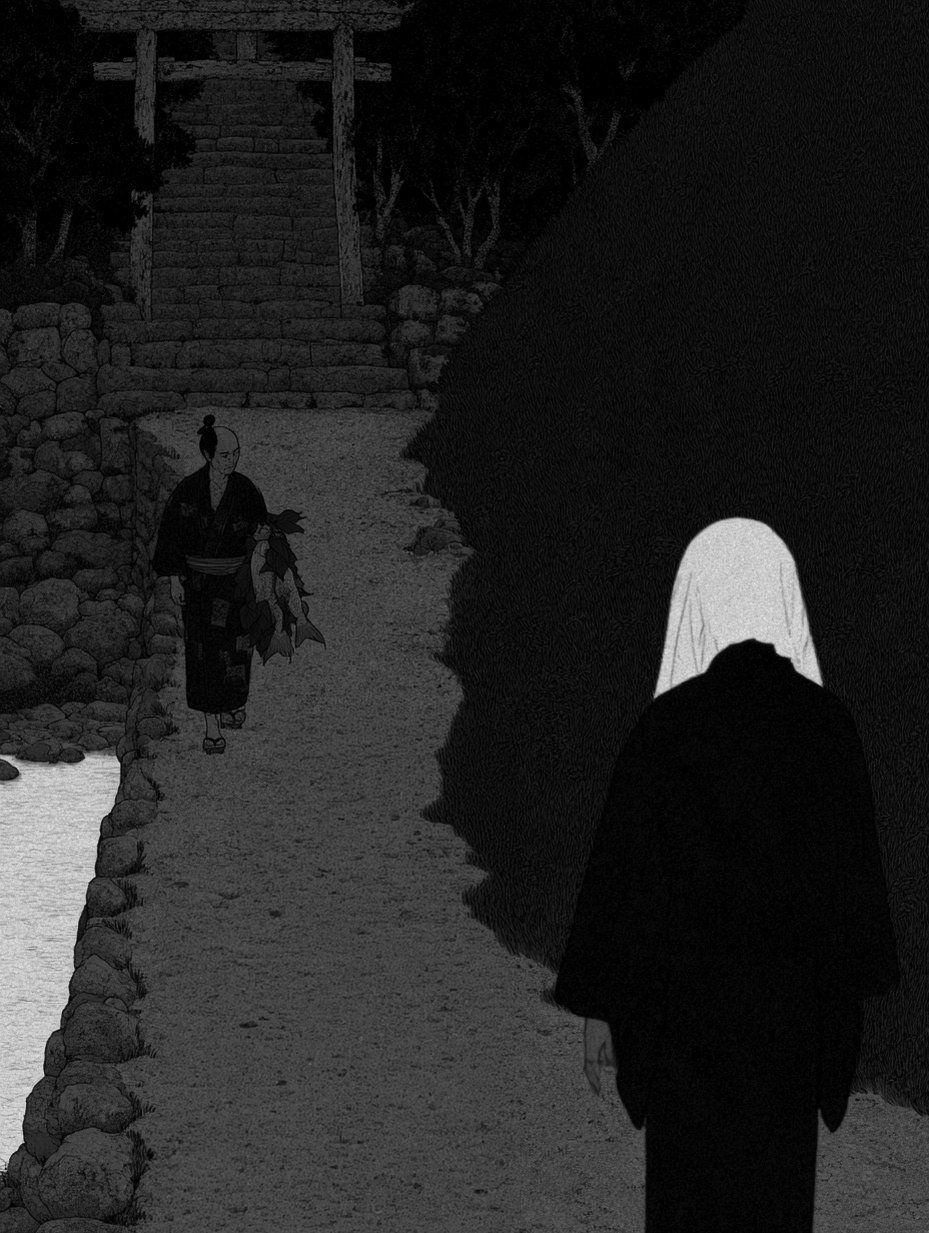
Now the book that gives this note its subject: a popular collection of debunked wonders by the same author, published in the 1890s, with a heading that names a destination.
He had heard, he writes, that the inugami was commonest in a certain part of the country. Then that within that part, it was commonest in a certain province. So he travelled to that province, wanting to see an inugami.
Somebody obliged him. If you want to see one, he was told, go to such a town; that is where there are most of them.
And he sets out the deduction in full, as a small syllogism. If the country’s greatest concentration is in that region, and the region’s is in that province, and the province’s is in that town, then that town is plainly the place in all Japan with the most inugami. Whereupon — the sentence is his — how could I possibly return to Tokyo without going there?
So he routed his onward journey through it.
The Word He Used Twice
Twice in that short passage he reaches for the same word: meibutsu. The local specialty. The thing a place is known for and a traveller goes to see.
He applies it to the belief itself — worth adding, he writes, to the list of that region’s specialties — and then again to the town, calling the inugami the one and only specialty of the place.
It is the vocabulary of a guidebook. The families who were refused marriage are, in that sentence, what the town produces.
What He Found
He arrived, and asked, and was told that in recent years, owing to the spread of elementary education, the local specialty had been declining year by year, and was now not easy to see.
His conclusion follows at once. Education and the inugami, or fox-possession, stand in exact inverse proportion; the two cannot coexist. How great, then, is the power of education.
He is right about the trend, so far as this note can tell, and right that it was worth being glad about. He also came a long way to look at it before it went, and was disappointed to have missed it.
What the Printing Did
Here is the part that is not about him.
Before that book, the knowledge was local. Which households in a given valley were said to be of that kind was something the valley knew, and the valley’s knowledge stopped at the ridge. That is bad enough, and it is the ordinary condition of this belief in every account we have.
Then a widely circulated volume, by a nationally known figure, aimed at a general readership and written expressly to destroy the superstition, printed the region, the province and the town, in ascending order of concentration, as an itinerary.
After that, a reader in Tokyo who had never been west knew where to be careful. A family arranging a marriage knew which place-name to ask about. The thing the ridge used to contain was now in a book anyone could buy.
The people in that town did not get a say in being the answer to the question. What they got was a sentence explaining that thanks to the schools there were fewer of them every year — printed under their own address, by a man who had come to see them and found the exhibit closing.
Sources
- Yōkaigaku 妖怪学, by Inoue Enryō 井上円了; the section of the psychology division on the inugami, which supplies all the quotations in this note: the making of an inugami from an Edo dialogue book; the comparison with Chinese poison-magic and the Chinese cases; the text describing the inheritance of the spirit, the inability to renounce it and the refusal of the village to intermarry; and the physician’s testimony, quoted there from an Edo miscellany, on fevers read as possession, the summoning of ascetics, and the deaths of patients who were not gravely ill.
- Yōkai hyakudan 妖怪百談, by the same author; the tale recording his journey, the informant’s direction, his deduction, his remark about returning to Tokyo, his two uses of the word meibutsu, what he was told about elementary education, and his conclusion about education and possession being in inverse proportion.
- The region, province, district and town named in that tale, the titles of the Edo works quoted at second hand above, and the name of the physician’s source are deliberately omitted here.
The readings in “The Word He Used Twice” and “What the Printing Did” are KWAIDANOTE’s own.
Found an error? Write to kwaidanote@gmail.com — corrections are made on this page and dated.