Lafcadio Hearn Named Two of Them
The Book Most English Readers Start From
For a great many readers outside Japan, Japanese ghost stories begin and end with one book: Kwaidan: Stories and Studies of Strange Things, published in 1904, the year its author died. The blind lute player whose ears are torn off, the faceless thing on the Akasaka road, the woman in the snow — these reached English through Lafcadio Hearn and have been reprinted, filmed and paraphrased ever since.
This site passes through him often. He stands behind parts of our notes on ghosts, on man-eaters, on foxes, and most of all on the snow woman. So it is worth being exact about what he did, which is neither as much nor as little as he is usually given credit for.
What the Preface Actually Says
The preface to Kwaidan is dated Tokyo, January 1904. It says that most of the stories in the book were taken from old Japanese books, and it names five of them.
Then it makes two exceptions, and only two. The snow woman story, it says, was told to him by a farmer of Chōfu, in Nishitama district, Musashi province, as a legend of that man’s own village. And a short final piece about a simple-minded man he had known is from his own life.
That is the entire apparatus. Which of the five named books produced which of the other fifteen pieces, the preface does not say, and neither does anything else in the volume.
The five are worth glancing at, because two of them are old friends of this site. One is a collection of strange tales; one is a Buddhist encyclopaedia; one is the thirteenth-century Kokon chomonjū, which our note on the fox cites directly; one is a book of miscellany; and one is simply a Hyaku-monogatari — a hundred tales, the standard title of the parlour-game genre our separate note describes.
So Hearn was reading, among other things, the printed residue of a Japanese ghost-story game of the seventeenth century, and turning it into English prose for readers in Boston. He gives the shelf but not the page, and a shelf is not a citation.
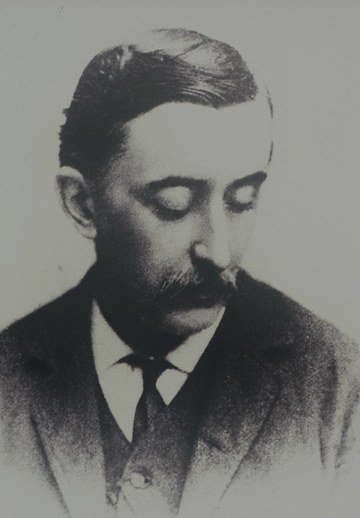
Lafcadio Hearn, photographed by Frederick Gutekunst. Public domain, via Wikimedia Commons.
Not Translation
The consequence is easy to see once you look for it. “Mujina,” the most-retold story in the book, carries no source at all: not in the preface, not in a note, not at the end.
“Rokuro-Kubi” looks at first as though it does. Two Chinese book titles appear inside it. But they belong to a character — they are what an educated man in the story knows about such creatures — and not to Hearn’s own reckoning of where he got the tale. The story ends by saying that this, at least, is what the Japanese story-teller declares.
He was retelling, not translating, and he said so in the only way he chose to: by writing in his own English, at his own length, and attributing when he felt like attributing.
The Person the Preface Does Not Mention
Hearn arrived in Japan in 1890 on a magazine commission he broke almost at once, taught at Matsue, then Kumamoto, then lectured at the Imperial University in Tokyo from 1896. In 1891 Setsu, of a Matsue samurai family, entered his household; in 1896 he was naturalized, took her family’s name Koizumi and the given name Yakumo, and the marriage was completed in law. He died in Tokyo in September 1904.
His Japanese never became good. Accounts of Setsu describe her as the one who found the stories — asking relatives and neighbours, and buying up old collections — and then telling them to him aloud.
The preface to Kwaidan does not mention her.
I want to be careful here, because it is easy to convert that sentence into a verdict and the evidence does not support one. What is established is that the preface to this particular book credits five old books, one farmer and Hearn’s own memory, and does not name his wife. What she contributed to which story, and what he said about it elsewhere, is a separate question that this note does not settle.
He Knew How to Do the Other Thing
It would be wrong to read the unattributed retellings as ignorance of method, because ten years earlier he had demonstrated the method plainly.
In Glimpses of Unfamiliar Japan of 1894 he tells the story of the great bridge at Matsue: how the piers would not hold, how a human pillar was resolved on, how the rule was that the first man to cross wearing a hakama without a gusset would be taken, and how a man named Gensuke was the one who crossed. The central pillar was called Gensuke’s pillar for three hundred years.
And then Hearn reports the sceptical explanation as well — that Gensuke may not have been a man at all, but the name of an era, garbled in transmission until it sounded like a person.
He could hold a story and a doubt about it on the same page. In Kwaidan he mostly chose not to.
The Story That Came Back
There is a last turn, and it belongs to the one story he sourced most precisely.
Nobody has ever identified the farmer of Chōfu, and the claim cannot be checked. Meanwhile, versions of Hearn’s snow woman plot — the hut, the promise, the marriage, the disclosure — begin to be collected from villagers in the 1930s, thirty years after the book. The scholarship on this takes the obvious view: the story went out from the book and came back as tradition. Our note on the snow woman sets out that evidence.
So the single case where he gave a precise oral source is also the case where the traffic can be shown to have run the other way.
How We Use Him
On this site Hearn is treated as what he demonstrably is: a very good writer of the 1890s and 1900s who recorded, reshaped and published material he mostly did not identify. He is evidence of what was circulating in his lifetime and of what a foreign writer could make of it. He is not evidence of what any earlier Japanese text said, unless that text can be found and read on its own.
That is not a demotion. It is the difference between a witness and a document, and Hearn, who printed the doubt about Gensuke, would have understood the distinction perfectly well.
Sources
- Lafcadio Hearn, Kwaidan: Stories and Studies of Strange Things, 1904; prefatory note, and the tales “Mujina,” “Rokuro-Kubi” and “Yuki-Onna.” Commons
- Lafcadio Hearn, Glimpses of Unfamiliar Japan, 1894; first series, chapter seven, for the bridge at Matsue and the pillar called Gensuke’s. Wikipedia
- Biographical dates follow the standard accounts of Hearn’s life and of Koizumi Setsu. Wikipedia
Further Reading
- Michael Dylan Foster, The Book of Yōkai: Mysterious Creatures of Japanese Folklore, 2015
The reading in “How We Use Him” is KWAIDANOTE’s own.
Found an error? Write to kwaidanote@gmail.com — corrections are made on this page and dated.