The Gashadokuro Was Invented in 1966
A Yōkai With a Byline
Most of what this site handles cannot be traced to a person. The tales are anonymous, the compilers are collectors, and the question of who made something up is usually unanswerable.
The gashadokuro is the exception. It has an author, a magazine, a month and a year.
It was put into print by Saitō Morihiro, a Japanese writer on science and the strange, in the November 1966 issue of a supplementary volume of a girls’ comic magazine, in a feature on Japanese yōkai. The thing he described there is the thing everyone now draws: an enormous skeleton, with the eyeballs still in it, making a rattling noise as it moves.
That is sixty years ago as this is written. It is younger than the first Godzilla film, younger than the transistor radio, and about the same age as the Tokyo monorail.
Where He Said He Got It
The part that makes the case worth an article is that he did not claim otherwise.
Saitō is reported to have said that he took the idea from a British ghost story — the Black Knight of Glamis Castle — which had been introduced to Japanese readers in the May 1965 issue of another magazine, a boys’ monthly from the same publishing house.
So the chain, as reported, runs: a Scottish castle legend, printed in a Japanese boys’ magazine in 1965; adapted eighteen months later into a Japanese yōkai for a girls’ magazine; and from there into every subsequent catalogue, video game, tattoo and film as an item of ancient Japanese folklore.
A creature can be invented, published under a name, credited by its own inventor to a foreign source, and be a national tradition within one lifetime. That is the finding, and it is not a scandal. It is how this works, and the only unusual thing here is that the paperwork survives.
A Note on What Is Being Claimed
This note has to be exact about its own footing, because the temptation in a case like this is to enjoy the debunking more than the evidence supports.
What has been verified is that an account exists naming the writer, the magazine and the month and year — all three — and giving the British source and its 1965 appearance. That account is a secondary reference work, not the 1966 magazine. The 1966 article has not been read for this note, and the 1965 one has not either.
The stronger claim — that nothing answering to this creature appears in any earlier Japanese source — is a negative, and negatives need the same proof as positives. The same secondary reference states it flatly. This note has not conducted that search, and does not assert the negative on its own authority. What it asserts is narrower: the positive attribution is documented, and no one has produced an earlier attestation.
The Picture Is Not of It
Now the second layer, which is the better one.
Search for this creature in English and you will be shown, almost every time, the same image: a colossal skeleton looming over a ruined palace, peering in at two figures. It is one of the most reproduced Japanese prints in the world.
It is by Utagawa Kuniyoshi, it dates from around 1845–46, and it is a triptych titled for the old palace at Sōma. It is roughly one hundred and twenty years older than the gashadokuro, and it is not a picture of one.
It illustrates a scene from a serial novel of 1806 by Santō Kyōden. The skeleton is a conjuration by Takiyasha, daughter of Taira no Masakado, confronting the warrior Ōya no Tarō Mitsukuni who has come to the ruined palace to investigate. It is a specific character’s sorcery in a specific story, and our note on the head of Taira no Masakado deals with that family’s afterlife in the Japanese imagination.
It has become the standard illustration for a creature that had not been thought of when it was painted, printed, or reproduced.
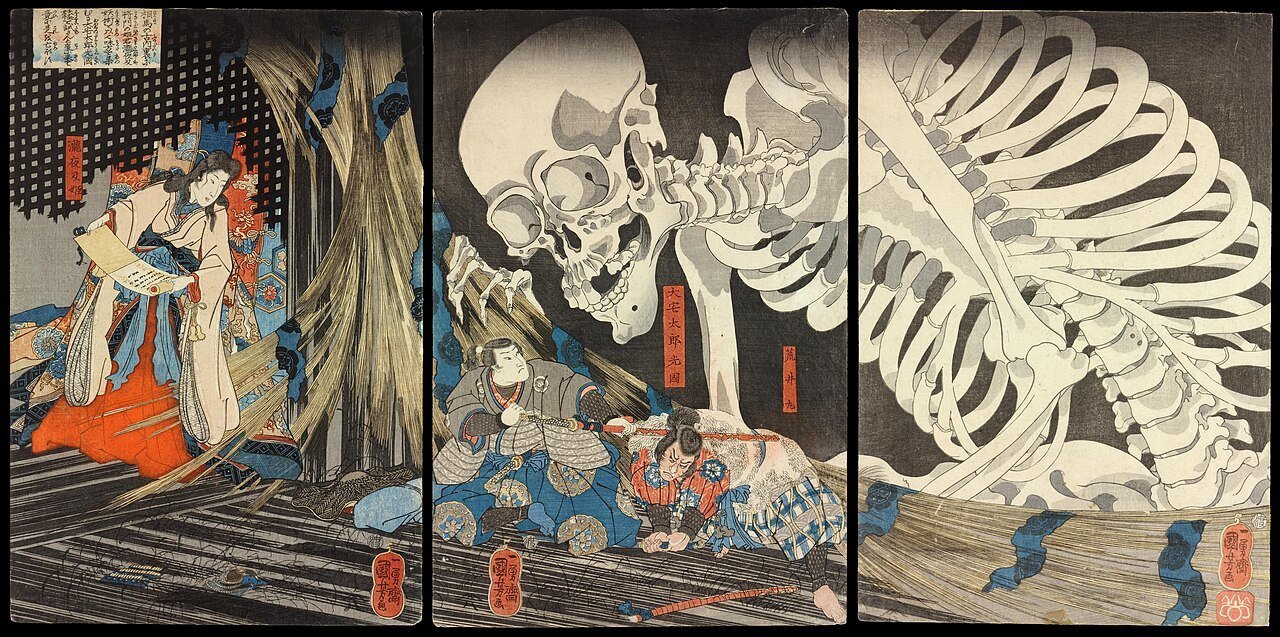
Utagawa Kuniyoshi, about 1844–46: Takiyasha’s conjuration against Mitsukuni — the print that now gets captioned with a name invented a century later. Public domain, via Wikimedia Commons.
Kuniyoshi Invented It Too
And there is one more turn, which is the reason to write this article rather than just correct the caption.
In the novel Kuniyoshi was illustrating, the sorcery produces many skeletons. A swarm. Kuniyoshi is consistently reported to have changed this — to have thrown the swarm away and painted one enormous skeleton instead.
So the single giant skeleton is not an old Japanese idea either. It is an 1840s print-maker’s compositional decision, made against his own source, because one huge skeleton filling three sheets is a better picture than fifty small ones.
The format is part of the explanation. The print is a sanmai-tsuzuki, a design published as three sheets meant to hang together, which gives an artist a wide horizontal field and a strong reason to fill it with one object rather than a crowd. The skeleton reaches across all three. Kyōden’s swarm would have been a busy picture; Kuniyoshi’s substitution is the sort of choice a professional makes at the drawing board, and it is the choice that has been reproduced ever since.
Which means that when Saitō, in 1966, needed a visual for his imported castle ghost, there was already a famous Japanese image of a single giant skeleton available to attach it to — an image that had itself been invented, for pictorial reasons, by a man departing from the text he was illustrating.
Two separate acts of invention, a century and a quarter apart, by two named professionals, neither of whom was recording a tradition. The result is now filed under tradition.
What This Case Is Good For
I keep this article on the site for a reason that has nothing to do with skeletons.
Every other note here works by going back to an earlier text and finding that the familiar version is later. That method has a limit, and the limit is that it cannot tell you when there is no earlier text at all — when the trail simply ends in a magazine. A reader who has been through the older material develops an instinct that everything has a twelfth-century ancestor if you dig far enough. It does not.
The gashadokuro is the control case. It is what a yōkai looks like when you can see all the way to the bottom, and knowing what that looks like is how you avoid claiming a bottom you have not reached.
The rattling giant skeleton is a fine piece of work. Saitō made something that people wanted, and Kuniyoshi made something better than the book he was paid to illustrate. Neither is diminished by being named.
Sources
- The attribution of the gashadokuro to Saitō Morihiro 斎藤守弘, in a feature on Japanese yōkai in the November 1966 issue of Bessatsu Shōjo Friend 別冊少女フレンド, together with the description of the giant rattling skeleton, and his own statement that he derived it from the Black Knight of Glamis Castle as introduced in the May 1965 issue of the boys’ monthly Bokura ぼくら: taken from a secondary reference work. Neither magazine issue was consulted for this note.
- The statement that the creature is a mid-twentieth-century creation with no basis in earlier folk transmission: the same secondary reference. No independent search of earlier sources was carried out for this note, and the negative is reported, not asserted.
- Utagawa Kuniyoshi 歌川国芳, the triptych of the old palace at Sōma 相馬の古内裏, around 1845–46; illustrating a scene of Takiyasha-hime and Ōya no Tarō Mitsukuni from Santō Kyōden 山東京伝, 善知安方忠義伝, a reading-book novel of 1806 (the reading of the title is not settled here).
- That Kyōden’s text has multiple skeletons and that Kuniyoshi replaced them with a single giant one: consistently stated across several independent secondary accounts, including a museum source. The 1806 text was not read for this note.
The readings in “Kuniyoshi Invented It Too” and “What This Case Is Good For” are KWAIDANOTE’s own.
Found an error? Write to kwaidanote@gmail.com — corrections are made on this page and dated.