Kokkuri Came Off an American Ship
Three Animals That Were Not There First
Kokkuri is written 狐狗狸 — fox, dog, tanuki. Every popular account starts from those three characters and reasons outward: a divination that summons three shape-shifting animals, a fox game, a piece of old Japanese animal belief that somehow survived into the modern classroom.
The oldest sustained Japanese account of the practice says the characters came last.
Inoue Enryō devotes a section of his lectures on the study of the uncanny to it, and he is explicit about the order. The name is from the motion: the lid tilts and nods — kokkuri — and from that tilting the thing was called kokkuri, and then Kokkuri-sama, and only then were the characters 狐狗狸 fitted to the syllables it already had. Fox, dog, tanuki are three graphs chosen because they are read ko, ku and ri. They are a pun applied to an existing word.
That is the opposite of the way the practice is usually explained, and it is the earliest explanation on record.
What He Says It Is
He is equally direct about what the thing actually was.
The table-turning and table-talking that Western spiritualists talk so much about, he writes — which translated straight into Japanese give kitenjutsu, the art of turning tables, and takuwajutsu, the art of talking tables — are completely identical with the kokkuri that has lately been practised in this country.
Not similar. Not analogous. The same thing.
He is right, and it is worth pausing on how unusual it was for a Japanese writer of the 1890s to reach for that comparison at all, rather than for a fox. Our note on Enryō sets out what he was doing and what it cost; this is one of the places where his method works exactly as it should.
The Ship
Then he gives a route, and the route is the part nobody quotes.
Around the seventeenth year of Meiji — 1884 — an American sailing vessel was wrecked near Shimoda, at the tip of the Izu peninsula. Among the Americans, one stayed in the area for a long time, and it is said that he taught the method to the local people.
Enryō himself was travelling in Izu in a later summer and heard of it there. The report of kokkuri reached him from that district in the eighteenth year of Meiji, 1885, and he takes that as the headwater of the nationwide craze. From Shimoda, he reasons, it must have gone west to Owari and Osaka and east to Bōsō and the Tokyo–Yokohama corridor — which is to say it travelled by port, along the coasting trade, the way a rumour moves when it moves by ship.
Every link in that chain is given as hearsay. The wreck is “it is said”. The American who stayed is “it is said”. Enryō is a man writing a book against credulous reporting, and on the origin of his own subject he has nothing better than what he was told in Izu. He prints it anyway, with the qualifier attached, which is the correct thing to do and worth noticing.
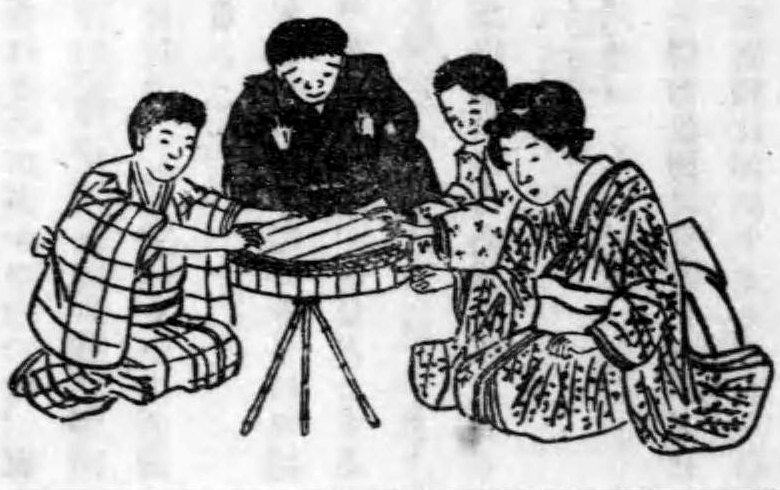
The three sticks and the lid, drawn by Miyatake Gaikotsu in 1922. Public domain, via Wikimedia Commons.
The Apparatus
The physical description is the most useful thing in the section, because it is the part that cannot have been embroidered.
Three bamboo poles, each between about thirty-six and forty-five centimetres, bound together with hemp cord to make a tripod. Over the top, a lid — the lid of a rice tub or a food vessel — with the three characters written on it. The participants rest their hands on the lid. The thing tilts left or right, and the tilts are the answers.
Anyone who has seen a table-turning séance will recognise it immediately, and so did Enryō. It is a small, cheap, domestic version of the parlour apparatus: no table needed, no medium, no fee. Three sticks and a pot lid is a technology that can cross a country in a year, and it did.
He records that the arrangement varied by district — Chiba, Jōshū, Shinshū, Osaka each had their own version.
What People Asked It
The cases he collected are the reason the section is not a curiosity.
A man near Shimoda asked kokkuri whether his wife had a lover. It answered that she did. He divorced her on the spot.
In one household there was a sick person lying in another room, and the sitters asked whether they would live or die. They were told the date, in that year, on which the person would die.
An unmarried woman at the same sitting asked when she would marry. She was told: this year, and her husband would be handsome.
Set those three side by side and the range is complete — a marriage destroyed, a household told when its patient would die, and a girl given a promise. The last is harmless and the first two are not, and the same tripod produced all three in the same rooms.
The Ban
In Osaka, he writes, it was for a time greatly in vogue, but harm followed from it, and so the police prohibited it.
That is the whole statement. No year is given for the ban anywhere in the section, and none could be found elsewhere in the volume, so this note cannot date it. The harm is not itemised either, though the divorce case and the death prediction sit a few lines away and it is not difficult to guess.
What He Wanted It For
Here the note has to be careful, because it would be easy to end with a scientist correctly dispelling a superstition, and that is not what is on the page.
Enryō’s purpose was not to explain kokkuri. It was to stop it. The identification with table-turning is offered as a demolition: this is a foreign parlour trick, it has no fox in it, the name is a pun, and the harm is documented. The cases are evidence in a prosecution.
The identification happens to be correct. But the man collecting a ruined marriage and a deathbed prediction was collecting them because they were useful to him, and a reader today gets the ruined marriage only because it served an argument.
I would rather have this section than a sympathetic one, and I do not think that is the same as approving of it. The sympathetic accounts of kokkuri that came later are full of foxes and short on dates, sitters, districts and consequences. Enryō is short on sympathy and has all of those.
What Is Left
Strip the section down and what survives is a small, precise, unwelcome finding.
A divination practice that everybody now files under Japanese fox belief arrived on the Japanese coast within living memory of the man describing it, in a form indistinguishable from an American parlour game, and acquired its foxes on the way — as a joke about how the syllables are spelt.
The foxes are real enough elsewhere; the notes on this site dealing with the fox and with possession are about belief that is genuinely old. This is not that. This is a nineteenth-century import wearing three borrowed characters, and the characters are the only Japanese thing about it.
Sources
- Yōkaigaku 妖怪学, by Inoue Enryō 井上円了; the section on the vogue of kokkuri. The identification with table-turning and table-talking, the derivation of the name from the tilting motion and the later fitting of the characters 狐狗狸, the wreck near Shimoda around 1884, the report reaching the author in 1885, the spread west and east by port, the bamboo tripod and lid, the district variants, the divorce case, the prediction of a sick person’s death, the marriage prediction, and the Osaka police prohibition are all taken from this section.
- On the date of the Osaka prohibition: not given in the section, and not established for this note.
The readings in “What He Wanted It For” and “What Is Left” are KWAIDANOTE’s own.
Found an error? Write to kwaidanote@gmail.com — corrections are made on this page and dated.